 Home
Home
CSB Graduate Nursing Student Handbook
The student handbook contains policies for students accepted to the Graduate Nursing Program. This handbook is reviewed annually for accuracy.
All newly developed or revised graduate nursing program policies or procedures will take effect immediately upon approval by faculty. All students will be notified via email of any policy changes and a copy of the email will be kept for record of student notification. Students will not be notified of editorial, non-substantive changes to the Student Handbook.
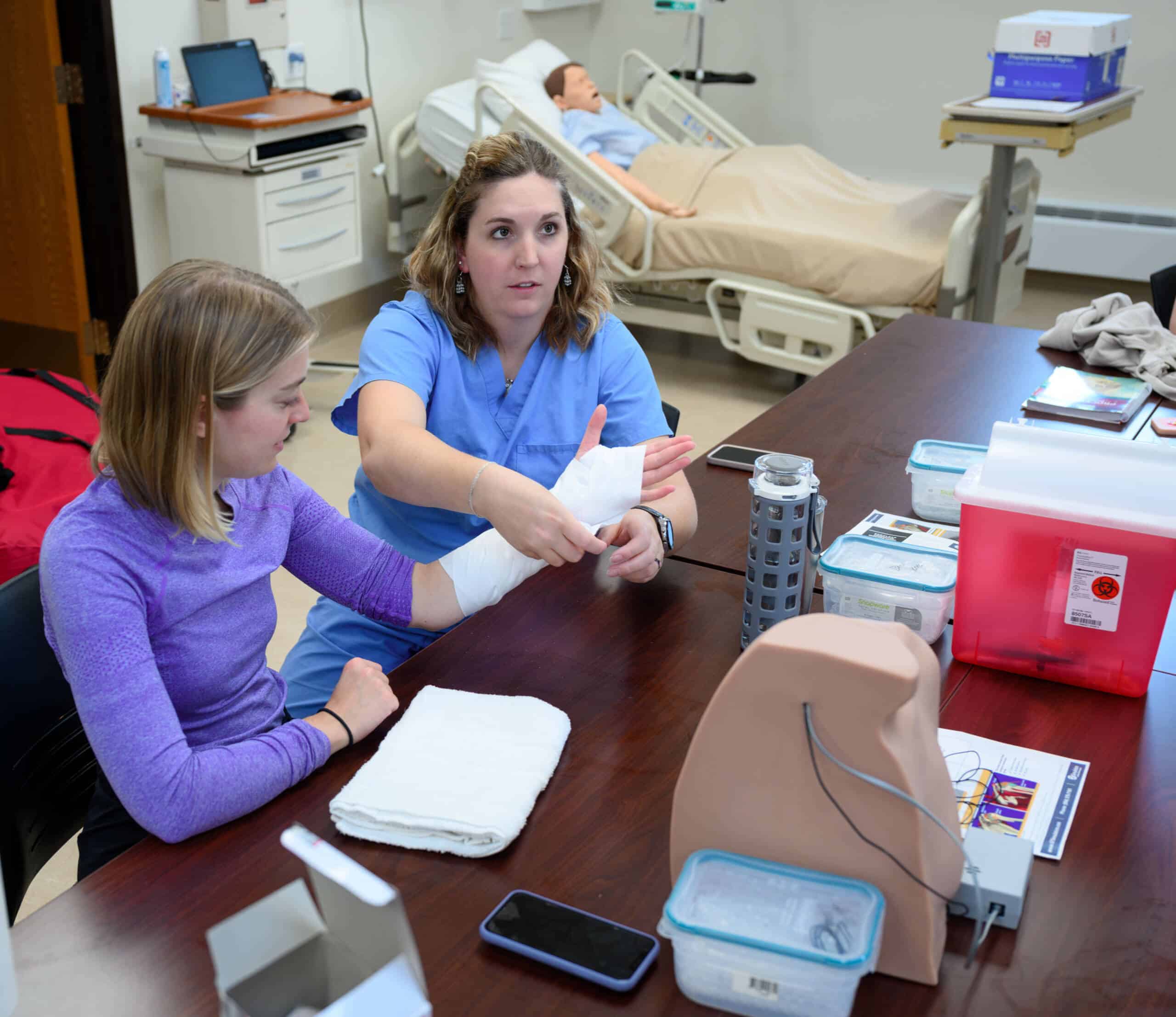
Attendance/Participation
Attendance and full participation in classroom (face-to-face and online), laboratory/simulation, and clinical experiences is expected. Most courses have an online (asynchronous) component and residency (face-to-face/synchronous) experiences. Some courses include laboratory simulated practice experiences and clinical performance expectations. Students are expected to be fully engaged in all modes of learning. A student who fails to demonstrate an adequate level of participation in a course will be evaluated accordingly and may receive a failing grade.
Absence must be communicated, and clinical absences must be made up. Absence is defined as not meeting academic obligations, including failing to participate in an online discussion or other online requirement, attend class, simulation experiences, or clinical experiences. Students must notify the faculty of any absence that would impact their ability to meet the course expectations. Students are required to attend all clinical experiences as scheduled. Clinical hours are mandatory so all missed clinical experiences must be made up. The student will be responsible for notifying the course faculty and clinical preceptor for any absence. The faculty will work with the student, but it is the student’s responsibility to arrange for clinical make up as appropriate. The student may be required to pay a fee for clinical make up. Students must appropriately plan for the time and rigor of clinical experiences. Students should anticipate completing 8-16 clinical hours a week once they start in their clinical practicum courses. Adjusting work and home schedules will be necessary to fulfill the clinical hour expectations. If for any reason, the student is unable to make up clinical experiences, the student will receive a failing grade for the course. Students who are unable to participate in the course, including online, face-to-face, or precepted clinical experiences for 2 weeks or more will be automatically and administratively withdrawn from the course.
Students are expected to engage in online courses on a regular and substantive basis. Regular engagement entails accessing and establishing presence in the online classroom at least 3 times during the calendar week. Students should check their email and course modules at least 3 times (preferably more) throughout the week. Substantive participation involves integration of the course learning materials into original analyses, robust participation in discussions, advancing what is written by peers and supporting this with scholarly sources, and responding fully to faculty questions. Most weeks in the online environment will include an online discussion. During discussions, students are expected to complete a main post and 2 peer responses on the due dates published in the course. Rubrics are provided and should be reviewed prior to submitting discussion posts to assure the student understands the evaluation criteria. Discussions require students are present in the discussion on 3 separate days. Student are expected to engage with peers in a collegial manner, respectfully advancing learning and appropriately citing sources using APA format (7th edition).
A student who fails to demonstrate an adequate level of participation in a course will be evaluated accordingly and may receive a failing grade. Students will be administratively withdrawn from a course if they do not demonstrate participation over a 2-week period, are unresponsive to instructor inquiries, fail to notify the College of their intent to withdraw, or fail to pass at least one course in a term. Lack of adequate participation leading to administrative withdrawal can lead to the requirement for the return of federal financial aid previously awarded to the student. Students are responsible for pay for any outstanding balance created by return of federal student aid funds.
Course Access and Federal Financial Aid
In accordance with the U.S. Department of Education’s guidance regarding regular, substantive class participation, CSB+SJU requires that all students must access the course within the first 5 calendar days of the course AND submit their required Week 1 assignments within each course during the first 7 calendar days. Students who fail to log-in and access the course within the first 5 calendar days will be administratively withdrawn from the course. The online week begins on Monday (Day 1) and concludes on Sunday (Day 7). Students must access the course by the first Friday to maintain enrollment in the course. Students failing to submit Week 1 assignments by Day 7 must communicate the reason for the delay with the faculty member and determine a plan of action. Students who do not develop a reasonable plan for submitting Week 1 assignments by Day 7 will be withdrawn from the course. Financial Aid cannot be released without class access and participation within the first 7 days of the term.
Clinical Compliance
Students participating in clinical experiences are representing the College of St. Benedict and are expected to adhere to all clinical requirements and expectations for professional advanced nursing practice and performance. In addition, the Graduate Nursing Program reserves the right to require a student to undergo professional evaluation regarding personal health issues as a condition of continued enrollment in the program. The student will be responsible for any diagnostic or treatment costs. Optimal management of health is encouraged. In the event of diagnosed or undiagnosed health issues, the student will remain accountable to the expectations of the program and profession.
Adherence to clinical requirements is essential for progression in the graduate nursing program. Students who do not adhere to these requirements will be subject to disciplinary action (see Disciplinary Policies). Students will be responsible for maintaining records needed to comply with contractual requirements of clinical facilities and supply these facilities with copies of all required documentation when requested. Clinical requirements include, but are not limited to:
CPR Certification
Current CPR certification from the American Heart Association-Healthcare Professional BLS Provider is required. Recertification must occur prior to expiration.
Registered Nurse Licensure
All students must submit evidence of a current, unencumbered RN license and be registered in the state of Minnesota prior to the start of the first graduate course. Students must also provide evidence of a current Registered Nursing license in the state where clinical experiences are completed. Updates to the licensure must be provided to the Graduate Program Chair upon renewal.
RN Clinical Practice Hour Documentation
DNP-FNP students must submit evidence of a minimum of 2000 practice hours as a Registered Nurse to the Graduate Nursing Chair prior to enrolling in APN I and Clinical Practicum I courses.
Malpractice Insurance
Malpractice insurance is required for DNP-FNP track students prior to the start of the first clinical rotation. Evidence of insurance must be submitted to the Nursing Department prior to the start of the first clinical experience. Failure to submit malpractice insurance will delay any clinical experiences until the insurance evidence is received.
Health Screening
Students are required to provide clearance by a health care provider upon acceptance to the program, including a current physical examination. Students must report any significant changes in their health status to the Department of Nursing as they arise. The Graduate Nursing Chair reserves the right to require a health care provider’s statement approving a student’s return to course/clinical activities.
Tuberculin Testing
Tuberculosis screening is required annually through a tuberculin skin test (TST) or a QuantiFERON blood test. Students who have a positive TST will need to provide proof of a negative chest x-ray (CXR) and then will need to repeat the CXR if they experience symptoms of tuberculosis. A screening questionnaire for active disease completed by a health care provider will be required annually. Proof of absence of active TB must be submitted to the Department of Nursing annually. Clinical circumstances or international travel may require more frequent testing as defined by the Centers for Disease Control or clinical placement sites. If the TST is contraindicated, then the student must provide evidence of a negative CXR and will need to repeat the CXR if they experience symptoms of tuberculosis. A screening questionnaire for active disease completed by a health care provider will be required annually.
Proof of Vaccinations
The following immunizations will be required for all students accepted to the program: MMR vaccine series completed or titer, Tdap booster administered after age 11 and TD booster every 10 years, HepB (completed three-dose series OR first dose administered by final acceptance to the program with completion of series within 6 months), varicella vaccine or titer, influenza (annual) or declination, other vaccines may be required as directed by clinical placement facilities.
Criminal Background Study
A criminal background study is required for all nursing students to verify that the student can provide direct patient care. Students who are not cleared will be restricted from participation in clinical activities.
Urine Drug Screen
Students must provide documentation of a witnessed negative 7-panel urine drug and alcohol screen within the timeframe and by the deadline specified. The 7-panel drug screen and alcohol screen must include: amphetamines, cannabinoids, cocaine, phencyclidine, opiates, barbiturates, benzodiazepines, plus alcohol with adulterants testing. No online or mail-in drug screen testing will be accepted. Results must come directly to the Department of Nursing. Student may be subject to random urine drug testing at any time to remain in compliance with clinical agency requirements. Students bear the cost of the screening. A positive result for the drug and alcohol screen will result in implementation of institutional policies. According to these policies, a student who is experiencing health issues associated with the use of chemicals may be required to undergo professional evaluation and treatment (at the student’s expense) for continuing enrollment. Testing positive for illegal substances will result in a report to the Minnesota Board of Nursing and to other relevant Boards of Nursing as indicated by the student’s current practice. A positive urine drug and alcohol screen may result in the inability to complete the clinical requirement of courses and may subsequently affect progression through the graduate nursing program.
Complaint Policy
Formal complaints against the Department of Nursing are defined as grievances provided in writing (email included) to the graduate chair. Formal complaints must identify the person filing the complaint (signed if a hard copy) and the date. The document must state that the individual is filing a formal complaint.
- The graduate chair will recommend that the person filing the complaint discuss the matter directly with the parties involved and seek resolution to the problem. A copy of the formal complaint will be provided to named individuals.
- If the matter remains unresolved, the graduate chair will work with the person filing the complaint to continue the process for seeking a resolution to the problem. If the complaint is against the undergraduate chair or chief nursing officer, the Academic Dean or Dean’s Designee will serve in this role.
- If the matter remains unresolved, the person filing the complaint will be referred to the appropriate grievance procedures for the College of Saint Benedict/Saint John’s University.
- Documentation of action/resolution in response to the complaint will be stored securely in department electronic files. A request to withdraw the formal complaint must be submitted in writing and will be filed with the original complaint.
- Should a consideration be made to file a formal complaint about the program to an accrediting or approving body, the student must follow the criteria and process established by that agency.
Disciplinary Policies
To progress in the program, students must fulfill both academic and professional requirements. Information about College/University policies including details about student rights, such as the right to appeal can be found in the Academic Catalog as well as in the J Book and Bennie Book.
Academic Probation
Students who do not achieve a 2.5 or higher undergraduate nursing GPA or a 3.0 or higher graduate cumulative GPA, which includes pre-requisite, co-requisite, and NRSG-designated courses, will receive a notification of academic probation from the Office of Academic Advising. The undergraduate or graduate chair are responsible for notifying the Office of Academic Advising of any students who do not meet these criteria.
Undergraduate students have one semester to improve their nursing GPA at or above 2.5. Graduate students have one semester to improve their nursing GPA at or above 3.0. If the cumulative nursing GPA (pre-requisite, co-requisite, and NRSG-designated courses) is not 2.5 or above for undergraduates or 3.0 for graduate students at the end of the following semester, the student will be terminated from the nursing program. Grade appeals related to academic probation follow the college/university policy and procedures in the Academic Catalog.
Academic Misconduct
In situations involving academic misconduct, the college/university policy and procedure will be followed. Students suspected of engaging in academic misconduct will be reported by the course faculty through the appropriate college/university channels. The decision about academic misconduct allegations will be processed by college/university officials and communicated to the undergraduate or graduate chair. As a result of the academic misconduct decision, the undergraduate or graduate chair will be advised by college/university officials about placement of the student on a Level I or Level II Contract. Appeals for academic misconduct follow the college/university policies.
Unprofessional Behaviors
Students will be informed of behaviors/performance inconsistent with program expectations as well as professional nursing standards. This policy outlines the procedure to be followed if student outcomes and/or behaviors do not meet the expectations of the program or profession. Student expectations and relevant professional standards are communicated at orientation and via the Student Handbook.
The nursing department reserves the right to require a student to undergo professional evaluation regarding personal health issues as a condition of continued enrollment in the program. The student will be responsible for any diagnostic or treatment costs. Optimal management of health is expected. In the event of diagnosed or undiagnosed health issues, the student will remain accountable to the expectations of the program and profession.
The nursing department reserves the right to take whatever actions deemed appropriate, including immediate dismissal from the program, if the performance/behavior is deemed particularly egregious. The nursing faculty advisor has no role in the disciplinary proceedings. The role of the advisor is to contact advisees and determine needs, counsel advisees about conflict resolution, supporting advisees to take ownership of behavior/performance issues, assisting advisees with seeking appropriate resources/services, and refer parental/outside inquiries to the appropriate chair. If the nursing faculty is the advisor of a student undergoing disciplinary action and is a member of the Admissions, Progression, and Recruitment (APR) Committee, then that faculty member should recuse themselves when disciplinary action pertaining to that student is being addressed. An advisor may also be reassigned depending upon the circumstances.
A. DOCUMENTED WARNING (MINOR, CORRECTABLE INFRACTION)
1. Students exhibiting minor, correctable, isolated unprofessional behavior, are provided with a documented warning notification and constructive advice for modifying behavior(s) to meet professional standards. The faculty will utilize the Notice of Disciplinary Procedure Form Documented Warning and submit this to the chair of the APR committee, respective office manager, and the student. This does not require a student signature. This form should be placed in the student’s file. The faculty initiating a minor correctable infraction warning will inform the course coordinator, faculty advisor for student, and as needed other nursing faculty involved with the student. The student is expected to modify the behavior accordingly. If the behavior is not modified or if new unprofessional behaviors arise, the instructor initiates Level I or Level II action.
2. Since a documented warning is a mechanism for communicating behavior/professional performance expectations, there is no appeals process for notifying a student of such expectations.
3. Names of students receiving a documented warning are entered into the disciplinary procedure tracking document accessible only to faculty within the nursing department.
B. LEVEL I CONTRACT
1. Students exhibiting repeated or multiple minor correctable unsatisfactory professional and/or personal behaviors, require a Level I Contract. In certain allegations of academic misconduct, college/university officials may recommend a student be placed on a Level I Contract.
2. The behaviors/performance(s) cited will be recorded on a Notice of Disciplinary Procedure Level I Contract form. The faculty/course coordinator initiating the contract will designate specific issues on the form , establish the explicit expectations and timeframe, and establish conditions for removal of the Level I Contract or consequences if the terms are not met.
3. The student, the faculty initiating the contract, and the APR chair will review and sign the Notice of Disciplinary Procedure Level I Contract form.
4. Since a Level 1 Contract is a mechanism for communicating behavior/professional performance expectations, there is no appeals process for notifying a student of such expectations.
5. Names of students receiving a Level 1 Contract are entered into the disciplinary procedure tracking document accessible only to faculty within the nursing department.
6. The faculty or course coordinator initiating the Level I Contract will inform other faculty teaching in the relevant course(s), the student’s faculty advisor, and the chair of the APR committee of the reason for and terms of the Level I Contract. The coordination and monitoring of the contract remains with the faculty member who initiated the contract. Academic officials are not typically notified of students placed on a Level I Contract.
7. At the beginning and at the end of each semester, all contracts are reviewed by the APR chair and relevant faculty/course coordinator(s). Students and faculty are reminded of the contract terms at the beginning of each semester. At the time of review at end of semester, Level 1 Contracts can be: 1) discontinued; 2) retained; or 3) escalated to a Level 2 Contract if warranted. Students will be notified of a change in contract status. A copy of the contract will be retained in the student’s file until graduation. If future unprofessional behaviors occur, the student may be placed back on a Level I or elevated to a Level 2 Contract.
C. LEVEL II CONTRACT
1. Students exhibiting the following should be placed on a Level II contract:
a. Unprofessional behaviors not improved through the guidance of a level I Contract and/or,
b. A significant egregious behavior/incident, persistent pattern, or multiple unprofessional behaviors or professional performance problems not previously documented; and/or,
c. Academic misconduct (if directed by the college/university to place the student on a Level II Contract).
2. The behaviors/performance(s) cited will be recorded on a Notice of Disciplinary Procedure Level II Contract form. The faculty or course coordinator initiating the contract will define the specific issues on the form, establish the explicit expectations and timeframe, and consequences if the terms are not met.
3. Prior to meeting with the student, the faculty or course coordinator initiating the Level II Contract should consult with the undergraduate or graduate chair of the nursing department, and APR chair with the completed Notification of Disciplinary Procedure Level II Contract form. The student’s faculty advisor shall be notified but has no role in disciplinary proceedings. The APR chair will consult with the members of the APR committee to ensure consistency across cases and adherence to department policy and procedures.
4. A meeting will ensue with the student, faculty or course coordinator initiating the contract, the APR chair, and the graduate or undergraduate chair. The student will be notified by the APR chair of the option to have an advocate present at the meeting. This advocate cannot be a nursing faculty member of CSB+SJU. The student may discuss the situation with the faculty advisor, but the advisor has no role in the disciplinary proceedings.
5. During this meeting, the student will be informed of the unsatisfactory behaviors using the above-mentioned Notice of Disciplinary Procedure Level II Contract form. The terms of the Level II contract will be discussed and the student made aware that meeting of these terms is essential for progression in the nursing program. The coordination and monitoring of the Level II Contract is the responsibility of the APR chair.
6. Students have the right to appeal Level II contract allegations. See STUDENT RIGHTS AND PROCESS FOR APPEAL below.
7. The Level II Contract is signed by the faculty or course coordinator initiating the contract, student, APR chair, and undergraduate or graduate chair of the nursing department.
8. The Level II contract is stored and retained securely in the student file in the nursing department until graduation. A copy of the Level II Contract is provided to the student (in person, via email, or via certified mail, if needed). The Assistant Dean/Director of Academic Advising and the Dean for Student Academic Success serve as resources to the student and will be provided with a copy of the Level II contract by the undergraduate or graduate chair of the nursing department.
9. The chair of the APR committee will inform the relevant faculty of students placed on Level II Contracts. The Level II contract information will be entered into the disciplinary procedure tracking document accessible only to faculty within the nursing department.
10. At the beginning and at the end of each semester, all contracts are reviewed by the APR chair and relevant faculty/course coordinator(s). Students and faculty are reminded of the contract terms at the beginning of each semester. At a meeting with the student at the end of each term, a Disciplinary Action Follow-up Form must be completed and signed by all parties. A copy of the contract and any follow-up forms will be retained in the student’s file until graduation.
11. Due to the serious nature of Level II contracts, the contract will be in effect through graduation.
D. TERMINATION FROM THE NURSING PROGRAM
1. The nursing department reserves the right to dismiss students for egregious infractions of academic or professional behavior regardless of previous discipline or lack thereof; failure to meet the terms of a Level II Contract; unsatisfactory academic standing; failure to comply with contractual requirements of clinical facilities; unsatisfactory progress towards the degree; or other reasons that significantly affect the health, safety, property, or welfare of the individual student, patients, healthcare agency, and/or healthcare agency staff.
2. Procedure
a. In situations where a student on academic probation in the nursing department does not achieve the minimum 2.5 cumulative nursing GPA (in pre-requisite, co-requisite, and NRSG-designated courses) in the semester following academic probation, the student will be terminated from the program. Appeals for termination related to academic probation should be directed to the Grade Appeal Policy in the Academic Catalog.
b. For students on a Level II Contract, if the undergraduate or graduate chair of the nursing department and involved course faculty deem that sufficient documented evidence exists to consider termination, the respective chair will consult with the Assistant Dean/Director of Academic Advising for guidance. If after these conversations, there is sufficient evidence to move forward, the graduate or undergraduate chair will document the evidence and submit this evidence to the APR committee. Depending on the circumstances, the student may be suspended from clinical or laboratory activities while the case is under review. If a member of the APR committee is the advisor to the student, they will be recused from review and deliberations.
c. The undergraduate or graduate chair of the nursing department will notify the student: 1) that a recommendation has been made for program termination, 2) the reasons for the recommendation, 3) that the student may provide a written response to the allegations within 48 hours for consideration by the APR committee, and 4) that the student has the right to have an advocate at the meeting, which will be scheduled following APR deliberations. To ensure that the notification has been received, the letter should be sent via email with return receipt requested. The student may discuss the situation with his or her faculty advisor, but the advisor has no role in the disciplinary proceedings.
d. The APR committee reviews the termination evidence and the student written comments and recommends retention or termination of the student to the undergraduate or graduate chair of the nursing department.
e. An in-person meeting with the student, APR chair, and undergraduate or graduate chair, along with an advocate for the student (if desired), is conducted to communicate the disciplinary decision. If the student is not terminated, a Level II Contract will be initiated, continued and/or revised. The Assistant Dean/Director of Academic Advising and the Dean for Student Academic Success are notified by the graduate or undergraduate chair of Level II Contract status.
f. If a student is terminated, the decision will also be communicated in a letter of Notification of Disciplinary Procedure Termination from the Program Form provided to the student at the meeting. The Dean of Curriculum and Assessment or Dean’s designee will be notified that the student has been terminated from the program and that the student has 48 hours to notify the undergraduate or graduate chair of the intent to appeal.
g. If the student is terminated from the program, fails to graduate, or withdraws from the program, the information shall be retained in the nursing department secure files for five years and then confidentially disposed.
STUDENT RIGHTS AND PROCESS FOR APPEAL
1. Students have the right to dispute academic probation by submitting a written grade appeal to college/university officials as directed by the Academic Catalog.
2. Students have the right to dispute academic misconduct allegations by submitting a written appeal to college/university officials as directed by the appeal policy in the Academic Catalog.
3. Students have the right to dispute Level II Contract infractions or termination from the program through a written appeal process to the Dean of Curriculum and Assessment or Dean’s Designee. Notification of the process to dispute Level II infractions will be provided on the Notification of Disciplinary Procedure Level II Contract form.
a. Students wishing to dispute a Level II, or termination decision must notify the undergraduate or graduate chair of the nursing department in writing within 48 hours of notification of the disciplinary decision. The undergraduate or graduate chair of the nursing department will then notify the Dean of Curriculum and Assessment or Dean’s Designee via email, cc’ing the student on the email, of the student’s intent to appeal and will provide disciplinary documentation.
b. The student must provide any documentation for appeal to the Dean of Curriculum and Assessment or Dean’s Designee in writing within 7 days of notification of placement on a Level II Contract or termination from the program.
c. The final decision to uphold or overturn the nursing department decision rests with the Dean of Curriculum and Assessment or Dean’s Designee.
REINSTATEMENT
Students who are terminated from the program for any reason are not eligible for reinstatement.
Dress Code
Classroom
There is no established dress code for regular classroom attendance in the Nursing Department. Students are advised to consult either the Bennie Book (CSB students) or The J-Book (SJU students) for information for any college/university policies related to dress code.
Clinical Experiences and Laboratory/Simulation Setting
Each student must adhere to the professional standards of the Nursing Department. The following dress code expectations are aligned with the standards of our clinical partners. Furthermore, these requirements may be amended at the discretion of the clinical or lab faculty.
- School uniform/lab coat: Most clinical and simulation experiences in the lab require the student to wear the school uniform or lab coat. Please consult with the course faculty or syllabus if you are unsure. The uniform/lab coat must be clean and reflective of professional standards.
- Community-based clinical experiences: General attire must be clean, in good repair, cover the body appropriately, and reflective of professional standards. Examples of attire considered inappropriate include, but are not limited to:
- Torn, ripped, or frayed clothing
- Sleeveless tops, halter tops, see-through blouses, or clothing that exposes the stomach or back
- T-shirts (except under appropriate attire) or sweatshirts with or without logos
- Apparel with camouflage patterns
- Jeans, jogging suits, crop tops, tight-fitting, or spandex apparel
- Anything excessively short (2 inches or more above the knee) or long (touching the ground).
- ID badge: The ID badge must be worn in all clinical settings. It must be clearly visible, worn above the waist, and unaltered.
- Hygiene, hair and nails: Hygiene and hair must be clean, neat, and non-offensive. Hair must be of a natural human hair color and pulled back/secured if longer than shoulder length. No hair ornaments, such as flowers or feathers, may be worn. Nails must be neat, trimmed. Artificial nails are not allowed. Clear polish only in acute care settings and in some settings, such as surgical settings, no nail polish is allowed. Use of fragrances is not allowed and any make-up worn must be natural and not excessive. Mustache or beards must be neatly groomed and relatively close to the face.
- Hats/headgear/face coverings: Hats or headgear are not allowed except for religious/cultural reasons. Face coverings are not allowed.
- Jewelry: Jewelry of any kind must not pose a safety or infection risk. In some settings, such as surgical centers, rings and other jewelry is prohibited. In general, rings limited to no more than 2 per hand and earrings of no more than 2 per ear. A small nose stud is allowed (no septum or rings). Ear stretched piercings must be replaced with a flesh-colored plug. No utility bars or other visible piercings.
- Tattoos: Tattoos that are offensive in any way to patients, co-workers, or others, such as those with profanity, nudity, violence, racial references, alcohol, or controlled substances, must be covered at all times.
- Chewing gum: No gum chewing in the presence of patients/clients.
- Walking boot: A walking boot is allowed only with an attached toe guard (purchased separately). If worn in surgical areas, students will not be allowed to enter the operating room.
Note: Each course may specify additional requirements in the course syllabus.
Drug/Alcohol Policy
The CSB+SJU Nursing Department requires that nursing students provide safe, effective, and supportive client care. To fulfill this responsibility, nursing students must be free of chemical impairment. To protect student and public welfare, the illegal use, possession, or distribution alcohol, controlled substances, drugs and/or drug paraphernalia on campus premises and off-campus in settings related to nursing department coursework is prohibited. No student shall come to class, laboratory, field experiences, or clinical settings under the influence of alcohol, marijuana, controlled substances, or other drugs that can impair cognition and function. Evidence of usage or reasonable suspicion will result in immediate dismissal of the student from the setting, and additional follow-up.
Reasonable suspicion of use may be based on, but not limited to, one or more of the following:
- Smell of alcohol or drugs
- Impaired alertness, perception, coordination, reactions, responses, or effort
- Suspected impairment that has the potential to affect the safety of others
Procedure:
- If the clinical agency, faculty, or fellow students form a reasonable suspicion that a student has used, is using, possessing, transferring, or selling alcohol or illegal drugs, the faculty will notify the graduate chair.
- The student may be tested according to the clinical or supervising agency’s drug and alcohol testing policy. Faculty reserve the right to request drug and alcohol testing if there is reasonable suspicion in a class, laboratory, field experience, or clinical setting.
- The student will be responsible for the fees associated with the testing. The nursing department will provide financial assistance, or payment plans for required drug testing for students demonstrating financial need. Students may request confidential financial hardship consideration through the Financial Aid Office. Alternative testing schedules may be arranged to minimize costs while maintaining safety requirements.
- The student will be immediately dismissed from the site after the student has arranged for safe transportation. This transportation must be deemed appropriate by the faculty.
- The clinical faculty will follow the appropriate disciplinary procedures.
- If a student has a pattern of behavior that suggests alcohol or drug misuse, the graduate nursing program chair or APR Committee can request documented infractions from CSB+SJU.
- The graduate nursing program chair will notify the appropriate CSB Dean of Students. Further disciplinary action may be taken.
- The student will not be allowed to continue in the class, lab or clinical setting until the student submits a documented drug and/or alcohol screen.
Grading Policy
Student performance is evaluated by qualified faculty and reflects achievement of expected student outcomes as defined in the syllabus. All faculty listed in the syllabus are qualified faculty (as documented on the Faculty Qualification Grid). In the event of a calculated score, faculty will round to the nearest whole number for the final course grade. (For example, if the final grade is 91.5%, this would be rounded to 92%; if the final grade is 91.49%, this would be rounded to 91%). The graduate nursing grading scale is published in the course syllabus as follows:
| Grade | Achievement | Range | Honor Pts. |
|---|---|---|---|
| A | Superior | 92-100 | 4 |
| AB | 88-91 | 3.5 | |
| B | Good | 83-87 | 3 |
| BC | 79-82 | 2.5 | |
| C | Satisfactory | 75-78 | 2 |
| CD | 70-74 | 1.5 | |
| D | Minimum Passing | 65-69 | 1 |
| F | Failure | 64 and under | 0 |
| H | Honors | ||
| I | Incomplete | ||
| S | Satisfactory | ||
| U | Unsatisfactory | ||
| W | Withdrew without prejudice | ||
| * | No grade report |
Grade Disputes
Grade disputes should follow the policies outlined in the Academic Catalog. Students have a right to learn the grounds upon which an instructor has graded their work. If, after discussion with the instructor, a student believes that he or she has been graded unfairly, that student may appeal to the department chair. The department chair will attempt to clarify the positions of both the faculty member and the student and find a consensus position. If the student is still not satisfied, petition may be made to the academic dean or the dean’s designee, who will implement the next appropriate process. If the instructor and the department chair are one and the same, the academic dean may be consulted at the second level of appeal.
Unless otherwise specified in this catalog, student appeals against other academic judgments should be conducted in like fashion: seeking knowledge of the grounds for a judgment from the relevant faculty member or academic official; moving to that person’s superior if the student believes the judgment is unfair; and then petitioning the academic or the dean’s designee if still unsatisfied. The academic program of each college is subject to the academic dean and then to the provost for academic affairs.
Graduation
Students must satisfactorily complete all program requirements, including successful completion of courses, clinical hours, and project-related activities to graduate from the program. All failing (“F”), and Incomplete grades must be cleared or completed by graduation day or the student’s name will be removed from the graduation list. A cumulative GPA of 3.0 is required. All college balances must be paid in full.
Laboratory/Clinical Safety Manual
I. INTRODUCTION
It is the intent of the faculty and administration in the Department of Nursing to provide a safe learning experience for all students.
The following policies and procedures are established to provide instructions in maintaining safety for students, staff and faculty while using the nursing laboratory (hereby referred to as “lab(s)”) within the CSB+SJU Department of Nursing and off campus clinical setting. These policies and procedures shall be adhered to by all concerned.
The Lab Coordinator along with the Nursing Department Safety Committee will update the contents of this manual every two years or more often as necessary. All students, staff, and faculty will be advised of these revisions. The CSB+SJU Director of Environmental Health and Safety serves as a resource to the Lab Coordinator and is to be consulted as needed with issues related to the safety of the lab. Note that this document is consistent with the safety policies and procedures of the Institutions. The Lab Coordinator is responsible for enforcing the regulations set forth in this manual.
II. GENERAL GUIDELINES
While using the labs, all faculty, staff, and students must know and practice the safety guidelines at all times. Failure to adhere to general guidelines can result in disciplinary action. This manual is available electronically on the Nursing Department homepage. Students will be instructed to review the contents upon admission to the clinical component of the curriculum and annually. The Lab Coordinator will ensure that faculty, teaching assistants, students, and student employees have up to date guidelines, policies, and procedures. Following the review, participants will be required to electronically sign and date a Forms Manager form acknowledging that they understand the policies and procedures of the safety manual. Failure to complete the form, will result in loss of the ability to use the lab. All equipment and supplies are intended to be used for training purposes only, with rare exceptions. All lab doors are locked unless occupied by faculty and/or students during class or practice. Students should at all times practice safe and appropriate techniques while in the lab. Students should be knowledgeable of the care, handling, and proper use of equipment prior to using it in the laboratory. Any initial and follow-up costs incurred related to illness/accident/needle stick exposure is the sole responsibility of the student.
III. LABORATORY SAFETY
A. Infection Control
- Universal precautions will be followed at all times (Refer to Blood Borne Pathogen Exposure Control Plan, Section I) when there is exposure or potential exposure to blood or body fluids.
- All laboratory and simulation experiences will mimic local health care institutional policies on infection control (i.e. use of PPE).
- Eating and drinking are not permitted in the laboratory spaces which include rooms 409, 410, 411, 412, 413, 414, and 418.
- Gloves are to be worn by students and faculty during any potential contact with blood and body fluids.
B. Physical Space
- All cabinet doors will be closed when not in use.
- The work spaces, floors, beds and desk areas will be kept clean.
- Any misconduct occurring in the lab will be reported to the Lab Coordinator.
- Malfunctioning equipment will be reported to the Lab Coordinator.
- Laboratory doorways will be clear at all times.
- The lab and supplies will not be used to provide medical treatment for students, staff, or faculty.
- Unauthorized personnel are not allowed in the labs at any time. Injury to unauthorized personnel in the lab will not be considered the responsibility of College of St. Benedict/St. John’s University.
C. Medications and Fluids
- When breaking glass ampules for practice, students will use ampule breaker devices.
- Placebos (candy pieces, commercially prepared PRACTI-med and water) will be used for simulation of oral/topical medications.
- IV fluids with expired dates may be used for practice and demonstration only.
D. Needle Safety
- The Lab Coordinator will annually review safety data on the needles and syringes we are using and complete the Safety Device Evaluation Form. The Lab Coordinator will send this information to the Director of Environmental Health and Safety of the colleges.
- All drawers with needles will be locked at the end of a lab session and containers, bags or equipment with needles will also be secured.
- Needles provided for practice of injection are used in the lab only when the teaching assistants or faculty are present. Students must demonstrate safety precautions while properly utilizing needles during practice.
- Needles will never be recapped after use. Used needles are to be disposed of the Sharps containers provided throughout the lab space.
- Needles and other sharp objects must not be discarded in the trash or left out openly in the lab at any time.
- Injection practice will only occur on the manikins or practice injection pads provided in the lab.
- Needles and syringes with expired dates may be used for practice and demonstration only.
E. Electrical Safety
- Wet materials may not be used around electrical outlets or equipment.
- Faculty and students are responsible for reporting to the appropriate faculty/staff any frayed electrical cords, cracked plugs, missing outlet covers, etc., as well as any problems encountered while using electrical equipment.
- No electrical cords will be left in the pathway of walking traffic. Extension cords will be properly taped to the floor if used over a walkway.
- Only three-prong plugs that contain a ground wire should be used to power equipment in the labs.
F. Ergonomics
- Students will be instructed in principles of body mechanics prior to practice.
- Students and faculty should use caution when lifting and should not lift equipment, manikins, or other students without assistance. When transporting manikins, stretchers and wheelchairs should be used.
- The wheels of all equipment (wheelchairs, stretchers and beds) are to be locked during practice and return demonstration.
- The ceiling lift will only be used with faculty or teaching assistant supervision.
- The sit-to-stand lift will only be used with faculty or teaching assistant supervision.
- The HoverMatt will only be used with faculty or teaching assistant supervision.
IV. CLINICAL SAFETY
Off-campus clinical experiences
- Students will follow the safety policies of the clinical institutions where they are participating in clinical experiences.
- In the absence of clinical institution safety policies, students will consult with faculty and/or Department Chair prior to performing procedures. Invasive procedures will be performed at the discretion of the assigned clinical faculty.
- Students should inform course coordinators of physical disabilities, recent injuries, illnesses, surgeries, and latex sensitivities/allergies* (see Addendum A at the end of the document for items containing latex) as soon as possible so that necessary precautions may be taken in the clinical setting. Medical clearance from a physician and permission of the Lab Coordinator and course instructor(s) may be needed before students with aforementioned concerns will be allowed to participate in clinical experiences.
V. INJURY
Reporting of an injury
- Any incident occurring in a course related lab or clinical must be reported immediately to the faculty or lab coordinator. The student accident report form must also be completed as listed in 4a below (in section V: Injury).
- A faculty member will assess the student/staff and administer first aid as needed.
- The faculty/staff/student will be directed or assisted to the Student Health Center, appropriate agency, or personal physician depending upon the nature of the injury. Campus Security may be called to assist in transporting a student to a health care agency or call 911 depending on the severity of the injury. Students will be responsible for any costs related to immediate and follow-up care that is provided by a health care agency.
- For student or faculty exposures the following form(s) must be filled out for the injury/incident.
- Student accident report form To report incidences that occur to students in academic proceeding – the student should NOT have been compensated for the procedure (e.g. labs, studios, workshops etc).
- Exposure Incident Report Form* To report an incidence where eye, mouth, mucous membranes, or even non-intact skin comes into contact with blood or other potentially infectious material. The student* should complete the form using the link with assistance from supervisor when necessary. If you are an employee (You must print and complete a hard copy (PDF) signed by your supervisor and submit to EHS). *Note this form asks for employee name. This form is for both employee and non-employee students. Please complete as directed.
- The Department Chair and/or Lab Coordinator will follow up with the student within 3 working days. A copy of the incident report and a written follow up report will be kept in the student’s file
VI. CLEANING AND MAINTENANCE OF THE LABORATORY AND EQUIPMENT
1. It is the responsibility of all those who use the lab for keeping equipment and the physical space clean.
2. Gloves are to be worn for personnel using harsh disinfectants to clean the lab.
3. Equipment located in the skills lab will be cleaned by teaching assistants as needed. The protocol for cleaning equipment is directed by the product manufacturer. Linen on beds will be changed and laundered when soiled, after extensive use, and at the end of each academic year.
4. The lab equipment will be kept in good working condition. Any faulty or broken equipment should be reported immediately to the Lab Coordinator.
VII. SHARPS AND BIOHAZARD WASTE DISPOSAL
1. Potential infectious wastes are collected, contained, stored, and disposed of according to the Occupational Safety and Health Administration (OSHA) guidelines. Signage will be posted as a reminder for proper disposal.
2. Sharps disposal is handled by a professional disposal service. When Sharps containers are full, a work order will be submitted for pickup of waste and delivery of an empty biohazard waste storage container.
3. The Lab Coordinator will contact the Environmental Health Safety Office to obtain empty sharps containers.
4. The Lab Coordinator will conduct a yearly evaluation of Sharps safety. The evaluation will examine clinical agency product and policy changes, as well as new Sharps-safety research and products. Laboratory supply and environmental upgrades/changes will be made accordingly.
VIII. EMERGENCIES
A. Fire
- Alert people in area to evacuate.
- Activate nearest fire alarm or call 5000 (Notify campus security).
- Close doors to confine fire.
- Evacuate to safe area or exit building through stairwell. Do not use elevator.
- Provide emergency personnel with any pertinent information. Students and faculty should become familiar with the location of the nearest fire extinguishers and pull boxes for fire alarm. Building diagrams that indicate fire escape routes and locations of fire escapes are located in each laboratory and by fire extinguishers.
B. Other Emergencies
Contact Campus Security (5000) and/or refer to the Emergency Response Procedures pamphlet, found near all of the doors in the Nursing Department, for other emergencies including: Active shooter/violent intruder, alcohol poisoning, assault, bomb threats, chemical spill, fire, medical emergency, mental health emergency or suicide attempt, severe weather, suspicious person or criminal activity, utility failure and weapons.
References: Please refer to the Environment Health and Safety Policies web page and the Emergency Response Procedures pamphlet.
Addendum A: Items with Latex within the Lab
*Items in the lab that have been confirmed to contain latex:
Nursing Anne Manikin
Bags simulating lungs inside manikin chest
Tubing simulating veins in the Multi-Venous IV Training Arm
Tubing connecting the red pulse bulb to the manikin, for manually generated carotid pulse
Red pulse bulb used for generating carotid pulse
Tubing on Blood Pressure Cuff provided with Nursing Anne
Nursing Baby Manikin
Bags simulating lungs inside manikin chest
Tubing simulating veins in the Multi-Venous IV Training Arm
Nursing Kid Manikin
Bags simulating lungs inside manikin chest
Tubing simulating veins in the Multi-Venous IV Training Arm
Nursing Kelly Manikin
Bags simulating lungs inside manikin chest
Tubing simulating veins in the Multi-Venous IV Training Arm
Tubing connecting the red pulse bulb to the manikin, for manually generated carotid pulse
Red pulse bulb used for generating carotid pulse
Tubing on Blood Pressure Cuff provided with Nursing Kelly VitalSim Capable
Noelle Birthing Manikin
Tubing simulating veins in the IV Training Arm
Nursing Program Fee
A nursing program fee is charged to all nursing students each semester. The program fee covers lab supplies and equipment, liability insurance, software, etc. The fee is reviewed and updated each semester based on program costs.
Progression and Program Completion
Progression
Program progression is dependent upon satisfactory academic performance, clinical performance, professional behaviors, and adherence to all policies and procedures outlined in this Handbook. Student performance will be monitored by the Graduate Nursing Chair and the APR Committee. Concerns will be communicated to the student, course faculty, and student’s advisor.
Satisfactory Academic Performance
Students must achieve a “C” or higher in each course AND maintain a cumulative grade point average of 3.0 AND remain in good academic standing to progress through the program.
A student whose cumulative grade point average falls below 3.0 or receives a grade less than “C” will be placed on academic probation (see Disciplinary Policies), which will remain in effect until graduation. Cumulative GPA will be tracked over subsequent semesters. At the conclusion of the any subsequent term, a student who does not achieve the required 3.0 cumulative GPA will be terminated from the program. For example, if the student obtains a 2.99 cumulative GPA in fall semester and remains 2.99 in the spring, this student will be terminated from the program.
Incomplete Grades
Students may request an Incomplete grade be applied to delay completion of coursework. Such extensions may not extend beyond the last day of finals (close) of the following term. For example, if the student is granted an Incomplete in Fall term, all coursework must be completed by the close of Spring term. Approvals to Incomplete requests and earlier limits to the deadline may be set at the discretion of the instructor. The instructor must report on the official grade roster the grade I, followed by the grade that the student will receive if the coursework is not complete by the end of the following semester (e.g., I/F, or I/C or I/B). That grade will be used in the computation of grade point averages until the incomplete is removed.
When coursework is received, the instructor will notify the registrar of the grade change from the I to the awarded grade. If the student does not complete the course requirements by the end of the following term, the provisional grade, which was assigned along with the I, will become a permanent part of the transcript. Degree candidates are cautioned that failure to have all degree requirements satisfied (including removal of incomplete grades in courses needed for graduation) by the dates set by the registrar will necessarily postpone their graduation.
Progressing to the Next Term
Students are required to achieve a grade of “C” or higher in each graduate nursing course. Students may not progress into the next term until the course in which the “C” was obtained is successfully repeated. A student may continue into the next term if an incomplete is applied, and that student is likely to successfully complete coursework from the previous term. The exception to this is if the courses in the next term hold prerequisites that have not been met. Then the student with an Incomplete is not allowed to progress into courses where the prerequisite has not been completed.
Repeating a Course
Graduate nursing courses can be repeated one time. If the student repeats a course and again receives a grade less than a “C”, the student will not be allowed to progress in the nursing graduate program and will be terminated from the program. A student is limited to no more than two course withdrawals (as noted with a W on the transcript) or retakes (or combination thereof) in graduate nursing courses.
Withdrawal/Leave of Absence/Return to the Program
In extraordinary circumstances, a student may need to withdraw from a course or from the program. A student is limited to no more than two individual course withdrawals throughout the program. A student who exceeds the two individual course withdrawals will be terminated from the program. Withdrawal deadlines are published by the registrar. If a student requests to withdraw from the program, the decision must occur by week seven and a half (7.5) of the term. For example, if the student wishes to withdraw from the program during Fall term, the notification must occur within 7-1/2 weeks of the start of fall term. Beyond 7-1/2 weeks, the student must continue in the term and receive the awarded grade. Students who withdraw from the graduate nursing program with or without intent to return, must provide a formal written Withdrawal Notification to the Graduate Nursing Chair. Email will suffice as a formal written Withdrawal Notification. The maximum length for a leave of absence is one (1) year. Students wishing to continue progression in the graduate nursing program at the conclusion of a one (1) year maximum leave of absence must notify the chair of the graduate nursing program of the intent to return no later than the first week of the preceding term. So, for example, if the student wishes to return fall term, then the student must notify the Graduate Nursing Chair by week one (1) of summer term. All leave of absence reinstatements and requirements for returning to the graduate nursing program will be made at the discretion of the Graduate Nursing Chair. Students who choose to return beyond the one (1) year maximum or at any point in the future must reapply to the program and be accepted in order to continue; the student will be considered a new applicant using established acceptance procedures.
The Graduate Chair will complete the following form to notify the registrar of the program withdrawal: Graduate Student Withdrawal Form
Time Requirements for Completion
All DNP-FNP or DNP-Leadership graduate students are required to complete the program within eight (8) years of the start date of the first course. So, for example, if a student takes their first course on August 25, 2024, they must complete all coursework and program requirements by August 24, 2032. All MSN-DNP or MSN graduate students are required to complete the program within five (5) years of the start date of the first course. Extensions to these completion time restrictions may be granted by the Graduate Nursing Chair in extenuating circumstances.
Requirements of the Program
Students are expected to comply with contractual requirements of clinical facilities. These include, but may not be limited to:
- Current CPR certification from the American Heart Association – Healthcare Professional BLS Provider required.
- Clearance by a health care provider including current physical examination and required up-to-date immunizations. Following acceptance to the major, students must report any significant changes in their health status to the department as they arise. The department reserves the right to require a health care provider’s statement approving a student’s return to class and/or clinical activities.
- Tuberculosis screening is required for final acceptance into the nursing major.
- Tuberculosis screening must be determined through a two-step tuberculin skin test (TST) or an approved blood test.
- Students who have a positive TST will need to provide proof of a negative chest x-ray (CXR) and then will need to repeat the CXR only if they experience symptoms of tuberculosis.
- If the TST or approved blood test is contraindicated, then the student must provide evidence of a negative CXR and then will need to repeat the CXR only if they experience symptoms of tuberculosis.
- Clinical circumstances or international travel may require additional testing.
- Students who travel to tuberculosis high-burden hybrid countries as defined by the Centers for Disease Control at the time of travel need to have their Tuberculin Skin Test (unless contraindicated) repeated 8-10 weeks following return to the U.S. if student experienced prolonged exposure.
- Clinical sites may require/request drug testing in compliance with the clinical site requirements (see Drug and Alcohol Policy).
- A criminal background study is required for all nursing students verifying the student is able to provide direct patient care.
- Additional vaccines or declination statements may be required per clinical agency requirements.
- Students will be responsible for maintaining records needed to comply with contractual requirements of clinical facilities and supply these facilities with copies of all required documentation when requested.
- If the required documentation is not received by the specified deadline, disciplinary action will be initiated per the Nursing Department Student Handbook.
- If a student is found to be ineligible for clinical placement at any time during the program, the student may be withdrawn from the clinical course.
- Students experiencing financial hardship in meeting health requirements should contact the department chair to discuss available resources, including:
- Payment plans for required health screenings
- Referrals to low-cost community health services
- Emergency financial assistance through Student Life
- Extensions for documentation when financial barriers exist when possible
Social Media Policy
Graduate nursing students are expected to comply with professional behaviors outlined by the student handbook, professional nursing standards, and ethical conduct in all communication, including online within social media platforms. The nature of social networks often contributes to the blurring of lines between private, personal, and professional information. The information posted or shared online by students is NOT confidential. Anything posted by a student, or anything a student is tagged by, is visible to the world-at-large and may impact student standing in the nursing program and may affect a student’s professional reputation.
For these reasons, graduate nursing students are expected to adhere to the American Nurses’ Association’s Principles for Social Networking (2011):
- Nurses must not transmit or place online individually identifiable patient information.
- Nurses must observe ethically prescribed professional patient-nurse boundaries.
- Nurses should understand that patients, colleagues, institutions, and employers may view postings.
- Nurses should take advantage of privacy settings and seek to separate personal and professional information online.
- Nurses should bring content that could harm patients’ privacy, rights, or welfare to the attention of appropriate authorities.
- Nurses should participate in developing institutional policies governing online conduct.
Graduate nursing students are also expected to adhere to The National Council of State Boards of Nursing guidelines (2011) to avoid problems on social media:
- Remember that standards of professionalism are the same online as in any other circumstance.
- Do not share or post information or photos gained through the nurse/patient relationship.
- Maintain professional boundaries in the use of electronic media. Online contact with patients blurs this boundary. Do not make disparaging remarks about patients, employers or co-workers, even if they are not identified (this includes clinical sites).Do not take photos or videos of patients on personal devices, including cell phones.
- Promptly report a breach of confidentiality or privacy.
Behaviors that are illegal, (e.g. violations of HIPAA, patient privacy, confidentiality) may be subject to legal action. If a report of inappropriate postings is brought to the department’s attention, members of the APR committee will investigate the report and follow established disciplinary procedures.
References
American Nurses Associations. (2011). Principles for social networking and the nurse. Silver Springs, MD: American Nurses Association.
National Council of State Boards of Nursing. (2011). White Paper: A nurse’s guide to the use of social media. Chicago, IL: National Council of State Boards of Nursing.
Additional Resources
https://www.nursingworld.org/content-hub/resources/workplace/social-media-dos-and-donts-for-nurses
Standards of Professional Performance
Attendance and participation in classroom, laboratory, and clinical experiences is mandatory. If the student is ill or otherwise absent, it is the student’s responsibility to notify the relevant course instructor, clinical faculty, and clinical unit prior to the scheduled class or clinical time. The student may be required to make up classroom and clinical activities to meet the learning outcomes and expectations. It is the student’s responsibility to arrange the clinical make-up with the appropriate clinical instructor. If not made up that semester, the student will receive an incomplete for the course and may not be able to progress in the subsequent courses until the clinical is completed successfully. A fee may be charged for the faculty coverage involved in the clinical make-up.
In addition, students are expected to adhere to professional behaviors in all contexts and activities related to CSB+SJU nursing.
QUALITY OF PRACTICE AND EDUCATION
Examples include but are not limited to:
- Provides safe nursing care during clinical experiences
- Punctual, attendance within expectations
- Completes tasks and assignments on time
- Completes tasks with minimal supervision
- Attentive and engaged in and out of the classroom
- Commitment to high academic standards; does not just “put in the time”
- Demonstrates application of theoretical knowledge to clinical setting
- Verbal communication is professional
- Nonverbal communication is professional
- Responsive to communication cues with appropriate situational adjustments
- Documentation is professional, legible, and complete
- Listens actively
- Courteous, polite
- Compassionate, supportive, reassuring
- Reliable and dependable
- Demonstrates sound judgment and clinical decision‐making
- Able to set priorities
- Responds appropriately to the emotional response of self, patients, clients, and/or family members
- Adheres to Department of Nursing/clinical site dress code
- Adequate personal hygiene and grooming
PRACTICE EVALUATION AND LEADERSHIP
Examples include but are not limited to:
- Demonstrates awareness of strengths and limitations
- Seeks assistance in evaluating practice when appropriate
- Accepts constructive feedback in a positive manner
- Takes initiative to improve and/or correct behavior
- Intervenes appropriately before issues become problems
- Demonstrates thoughtful self‐reflection
- Remains flexible and open to change
COLLEGIALITY AND COLLABORATION
Examples include but are not limited to:
- Attitude is collegial and cooperative
- Accepts and completes responsibility for own share of group work
- Shows respect and consideration for all group members
- Gives appropriate and timely feedback to other group members
- Communicates with others to resolve problems
- Respectfully acknowledges and discusses personal feelings and feelings of others
ETHICS
Examples include but are not limited to:
- Adheres to ANA Code of Ethics
- Prevents personal bias or feelings from interfering with professional interactions
- Focuses on the needs of patients, clients, and/or family
- Protects and respects patient autonomy, confidentiality and dignity including when engaged in on-line activities.
- Maintains appropriate professional boundaries
- Demonstrates a commitment to practicing self‐care, managing stress, and connecting with self and others
- Trustworthy
- Honest
- Respectful of others’ time (when requesting appointments, information, etc.)
- Demonstrates sensitivity to vulnerable and/or diverse individuals and/or populations
- Advocates for patient, client, and/or family
Technical Standards Policy
College Saint Benedict/Saint John’s University (CSB+SJU) Technical Standards for students enrolled in the graduate programs in nursing:
- Technical standards are a necessary component to the complex discipline of nursing, which all students must meet with or without reasonable accommodations.
- Students wishing to enter the CSB+SJU Nursing programs must be able to demonstrate that they can meet these technical standards and continue to do so throughout their nursing education program. Please thoroughly read the technical standards requirement to determine whether you can meet these with or without accommodations. See procedures listed below.
The CSB+SJU Department of Nursing is committed to equal access for all persons in its programs, facilities, and employment. The college/university abides by the Americans with Disabilities Act, Section 504 of the Rehabilitation Act of 1973, the Minnesota Human Rights Act and other applicable statutes and regulations relating to equality of opportunity. - The graduate nursing curriculum, requires students to engage in diverse, complex, and specific experiences essential to the acquisition and practice of nursing skills and functions. Unique combinations of cognitive, physical, psychomotor, sensory, communication, affective, and social abilities are required to satisfactorily perform these skills and nursing functions. These skills and functions are essential for the successful completion of the requirements of the Department of Nursing degree program and necessary to ensure the health and safety of clients, self, faculty, and other healthcare providers. As outlined below, these functions comprise the “Technical Standards” performance requirements for students.
- Procedures
- When applying to the major, students are required to review the policy and identify their capacity to meet the technical standards.
- If limitations in the ability to meet the technical standards are identified, the student is responsible for consulting with a qualified health care practitioner for further evaluation.
- If a limitation is verified by the health care practitioner, the student must present the recommended accommodations in writing to Student Accessibility Services.
- Student Accessibility Services will work with the student to request reasonable accommodations.
- As per Student Accessibility Services policy, the student must notify the faculty for each course about the requested accommodations.
- Once admitted to the nursing program, if there is a change in the ability to meet the technical standards the student must notify the course faculty and Student Accessibility Services immediately.
- Technical standards include but are not limited to the following abilities:
Cognitive
The student must be able to read and comprehend extensive written materials. The student must also be able to evaluate and apply information and engage in critical thinking in the classroom, lab, and clinical setting within the time constraints unique to each setting.
The student must be able to:
- measure
- calculate
- reason
- prioritize
- analyze
- integrate
- synthesize information
- act with integrity and judgment
- must have the ability to sustain attention and memory to maintain client safety.
Motor Skills
The student should have sufficient motor functions such that they are able to execute movements required to provide general care and treatment to clients in all health care settings. Such actions require: coordination of both gross and fine muscular movements, equilibrium, and functional uses of the senses of touch, vision, and hearing.
The student must possess the motor skills necessary for assessment and therapeutic procedures such as:
- inspection
- palpation
- percussion
- auscultation
- other diagnostic maneuvers and procedures
- CPR
- position clients
- operate equipment (IV pumps, cardiac monitor, electric and manual blood pressure equipment, safe client handling equipment, etc.)
Sensory/Observation
The student must be able to acquire information presented through demonstration and experience in the basic and nursing sciences.
The student must be able to:
- observe and hear the client accurately, at a distance and close
- observe non-verbal communications when performing nursing assessments and interventions or administering medications
- be capable of assessing the client. For example, sensory and observation information may be derived from visual inspection and images of the body surfaces, palpable changes in various organs and tissues, and auditory information (client voice, heart tones, bowel, and lung sounds, etc.)
- ability to read medication labels and markings on syringes.
Communication
The student must have the ability to communicate effectively and respectfully with other students, faculty, staff, clients, family, and other professionals.
Behavioral/Emotional/Conduct
The student must possess the emotional health required for the utilization of their intellectual abilities, the exercise of good judgment, ability to manage impulsivity, and the prompt completion of all responsibilities associated with the nursing care of clients and families. The student must possess the ability to reason morally and practice nursing in an ethical manner.
The student must be able to:
- maintain mature, respectful, and professional relationships with clients, students, faculty, staff, and other members of the health care team under all circumstances, including highly stressful situations.
- have the emotional stability to function effectively under stress and to adapt to an environment that may change rapidly and/or in unpredictable ways.
- demonstrate empathy for the situations and circumstances of others.
- recognize how their own values, attitudes, beliefs, emotions, and experiences affect their perceptions and relationships with others.
- willingly examine their behavior when it interferes with productive individual or team relationships.
- possess skills necessary for effective and productive relationships in diverse academic and work environments.
The student must be willing to learn and abide by professional standards of practice. They must possess attributes including:
- Compassion
- Empathy
- Altruism
- Integrity
- Honesty
- Responsibility
- Tolerance
- engage in client care delivery in all settings and be able to provide care to all client populations including but not limited to children, adolescents, adults, individuals with disabilities, medically compromised clients, diverse clients, and vulnerable adults.
The students are expected to follow the ANA Nursing: Scope and Standards of Practice and the ANA Code of Ethics for Nurses. (https://www.nursingworld.org/ana/about-ana/standards/)
Verification of Student Identity
Students who register for distance learning courses must be the same student who completes the course and receives academic credit. Therefore, student identification must be verified, and students provided with authentication information to allow access to the online environment. Students who do not adhere to this policy will be subject to disciplinary action.
Upon admission, IT Services provides each student with a network account and information on how to log-in as part of onboarding a new student. At first log-in, students are required to set-up two-factor authentication. With two-factor authentication, students are prompted to verify their identity when logging into their account using a pre-determined secondary device (such as their cell phone).
The user’s IP address indicates if they’re on-campus or not and if they are off-campus they face more rigorous checks on their identity than if they are on-campus. The is intended to stop identity theft with the assumption being if a user is on-campus using their credentials they are more likely to be “them” than if someone from off-campus is using the credentials.
Also, upon admission, students provide a recent photo to the nursing department, submitted to CSB Security, and this photo is used to create a student ID card. Photos must meet recent specifications as directed by CSB Security. Cards are processed by CSB Security and mailed to the students. This card allows access to library and other services when the student is on campus. Student photos are loaded into the Hive (student success portal) and held in a secure folder within the Nursing Department and distributed to faculty teaching in graduate courses. Every effort is made to protect the privacy of students. This includes securing access to photos and limiting distribution to CSB Security and the faculty teaching in graduate courses.
Students are required to use their cameras during synchronous class sessions and label their image with their full name so that their identity can be compared to the photo provided and verified by faculty.
The DNP program does not charge an additional direct fee for identity verification. If a fee must be charged in the future, due to verification of identity for proctored exams or other incurred charges, the student will be notified of the fee via email and the fee charges will be posted on the graduate nursing website.
Preceptor Policies and Procedures
Preceptor Selection, Qualifications, Orientation, and Evaluation (Criterion I.K)
In order to utilize a preceptor, students must be enrolled in a precepted course (with no greater than a 6:1 student to graduate faculty ratio) and are not to be compensated by the precepted clinical site. Preceptors must be qualified (academically and experientially) to facilitate learning. DNP preceptors must be individuals who hold a doctorate such as a DNP, PhD, DNS, EdD, MD, DO, etc. At a minimum, preceptors must have a graduate degree aligned with the program for which they are precepting and 1 year of practice experience in the professional role. DNP-Family Nurse Practitioner preceptors can be a NP, PA, Certified Nurse Midwife or a physician. Specific to DNP-FNP students, over the course of the DNP-FNP program, the student must complete a minimum of 120 hours with a nurse practitioner.
MSN preceptors must be individuals who hold are a licensed registered nurse who holds a graduate level degree such as an MSN, DNP, PhD, etc. Preceptors must have a current, unrestricted nursing or medical license in the state where the practicum will take place. A preceptor may supervise only one student on a given day. If more than one student is assigned to a preceptor, the preceptor must schedule the students on different days so that only one student is with the preceptor at any given time. A student may have more than one preceptor during a practicum experience. The use of multiple preceptors must be communicated to your faculty. Ensure you provide the CV for your preceptor(s) to the instructor within each of your project and practicum courses. DNP-FNP preceptors will also be required to submit additional documentation including their current license and certification.
NOTE: Preceptors cannot be a family member, relative or friend. Preceptors/mentors cannot be responsible for supervision of the student as an employee; the student cannot be responsible for supervising the preceptor/mentor in the workplace.
The Graduate Nursing Chair and the clinical coordinator will assure that appropriate clinical contracts are in place prior to the student initiating the precepted experience. For students assigned to CentraCare, priority will be given to students who are current employees of the organization and have a minimum of 2 years of professional experience as a registered nurse prior to entering the program. Students assigned to clinical facilities outside of CentraCare will be assigned based on their professional experience, learning needs and location.
Orientation for preceptors will occur in each precepted course and be conducted by the course faculty and/or the Graduate Chair. Within the first 3 weeks of the term, course faculty will arrange for a meeting with the preceptor and student to discuss the course expectations, student expectations, and preceptor expectations. Each preceptor will be provided with a copy of the preceptor handbook during orientation. A minimum of 2 visits will be completed each semester between the student, faculty, and site preceptor. These visits will be conducted virtually or in person depending on student needs and location.
Evaluation of preceptors will occur at the end of each course. Students will provide feedback on preceptor effectiveness using the designated evaluation form.
Preceptor files shall be kept in the CSB Nursing Department office and includes the following information for the designated semester/year assigned:
- Dates of preceptorship
- Preceptor’s name
- Preceptor’s current licenses
- Preceptor responsibilities (as designated by the assigned course)