
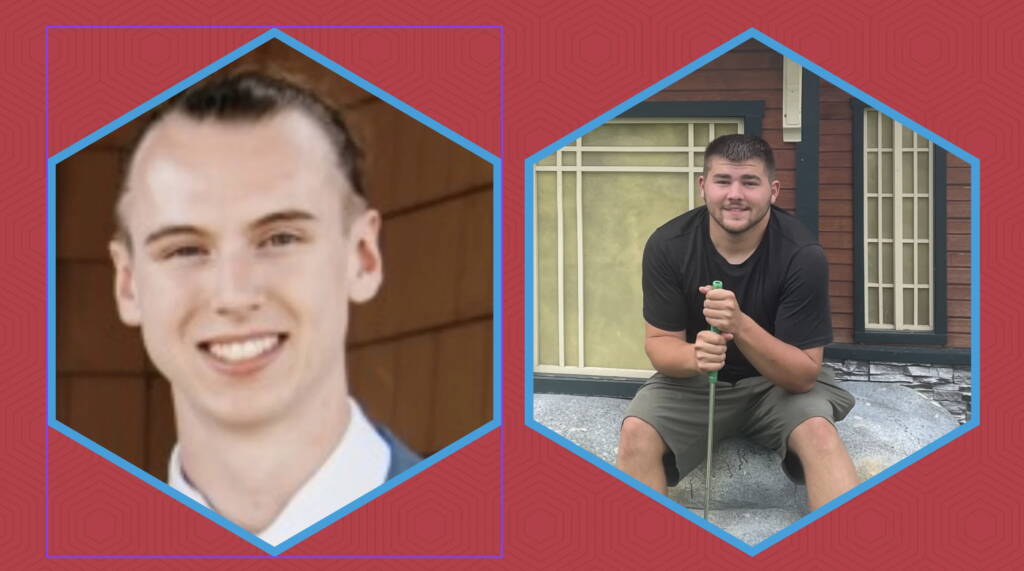
A pair of Saint John’s University students are spending the summer immersed in the integration of quantum reinforcement learning and artificial intelligence.
Under the direction of Dr. Srikanth Vemula, an assistant professor of computer science at the College of Saint Benedict and Saint John’s University, senior-to-be Tony Krystofiak and junior-to-be Timothy Flynn are enhancing a pre-existing virtual urban simulation model (originally developed by 2025 SJU graduate Andrew Nerud working with Vemula this past spring) by implementing quantum-enhanced reinforcement learning (QRL) algorithms.
Their work focuses on enabling multi-agent coordination between autonomous vehicles and UAVs, optimizing communication strategies for complex tasks such as search-and-rescue operations.
The trained algorithms will transition from simulation to a real-world deployment phase on Lake Sagatagan, where a drone and an autonomous surface vessel will collaboratively perform navigation and task execution. This experimental validation is backed by a $43,414 research grant awarded to Vemula to advance intelligent, trustworthy autonomous systems.
“I’ve always been pretty interested in AI research, and I just finished a quantum mechanics course this past semester,” said Krystofiak, a physics and computer science double major.
“Getting the chance to merge the two domains in a hands-on research project – and apply some of the things I’ve been learning in the classroom in a practical setting – was really appealing to me.”
In addition to the technical implementation of quantum-state decision policies, the students are rigorously exploring the interpretability and ethical ramifications of autonomous agent behavior.
Vemula emphasized the research carried out in Human-Centric eXplainable Intelligence Lab (hcXiL), is not solely about algorithmic performance, but also about building systems with explainable decision-making frameworks that meet safety, reliability and accountability thresholds for practical deployment.
“Tony and Timmy are not only getting exposure to advanced algorithms and advanced concepts, but we’re also adding an interpretability piece with the ethics portion,” Vemula said. “They’re figuring out not just how to train a system, but how to make it trustworthy enough that it can be used in a number of real-world scenarios.”
The project is one of 13 being sponsored by the Office of Undergraduate Research and Scholars at CSB and SJU. Each summer, the office provides summer collaborative grants to 13 student-faculty teams, helping them to complete a summer research project.
Krystofiak and Flynn are two of more than 60 students working on such projects on campus this summer.
Karyl Daughters, the dean of curriculum and assessment at CSB and SJU, said the projects help provide students valuable tools for future professional success.
“We know from research that engaged students have better, more satisfying undergraduate experiences,” Daughters said. “Summer undergraduate research is a high-impact form of engagement.
“(It’s) a cornerstone opportunity for our students,” she continued. “It is a transformative experience during which students forge mentoring relationships with faculty on meaningful projects that help them develop problem-solving skills, technical proficiency and intellectual curiosity.
“Summer undergraduate research transforms students from learners into creators, contributing to insights and knowledge about the world.”
Indeed, Flynn – a computer science major – said working on the project has helped him better understand the ways in which the concepts he’s been studying in the classroom might be one day put to use in his future career.
“In class, the things we’re studying have fixed outcomes,” he said. “But here, I get to make my own outcome. It’s a trial-and-error process that helps you see what works and what needs to be changed. It’s a chance to put something together, then test it out in a real-world environment.”