
Ana Dailey will enter the workforce when she graduates from the College of Saint Benedict next May.
Getting advance insight into some of the challenges and barriers she might face once she gets there played a big role in her decision to enroll in Gender and the Workplace, a 300-level gender studies course being offered for the first time this semester at CSB and Saint John’s University.
“I’ve never taken a gender studies course before, but I felt like it’s important to look at what injustices still exist, especially in the workspace,” the senior psychology and Hispanic studies major said. “This was a chance to learn more about what the future might hold and what can be done about it.”
Political science professor Pedro dos Santos was asked to step in after the person originally slated to teach the course was unable to this semester.
“Though gender studies are a part of my own courses, and I’m on the steering committee here, I’d never taught a class from just a gender studies perspective,” dos Santos said. “I saw it as a chance to really drill down and do something more ambitious. It was an opportunity to provide the students with more agency than they’ve had already.”
That’s reflected in the final project students are being asked to produce.
The only instruction dos Santos provided was that it focus on a topic outside the classroom and that it could be shared publicly. That’s led to students taking a number of different paths. The psychology majors in the class, which has 22 students enrolled in all, are looking at issues in that field. The accounting and finance majors have turned their attention that way.
One group is looking at issues in health, while another is focusing on sports – including conducting an interview with former CSB employee Jillian Hiscock, the owner of A Bar of Their Own, a women’s sports bar in Minneapolis. It’s part of a project examining media inequity when it comes to women’s athletics and what more can be done so support women’s sports in general.
“I want the students to create something they’re proud of, and even more ideally, something they can talk about in a job interview,” he said.
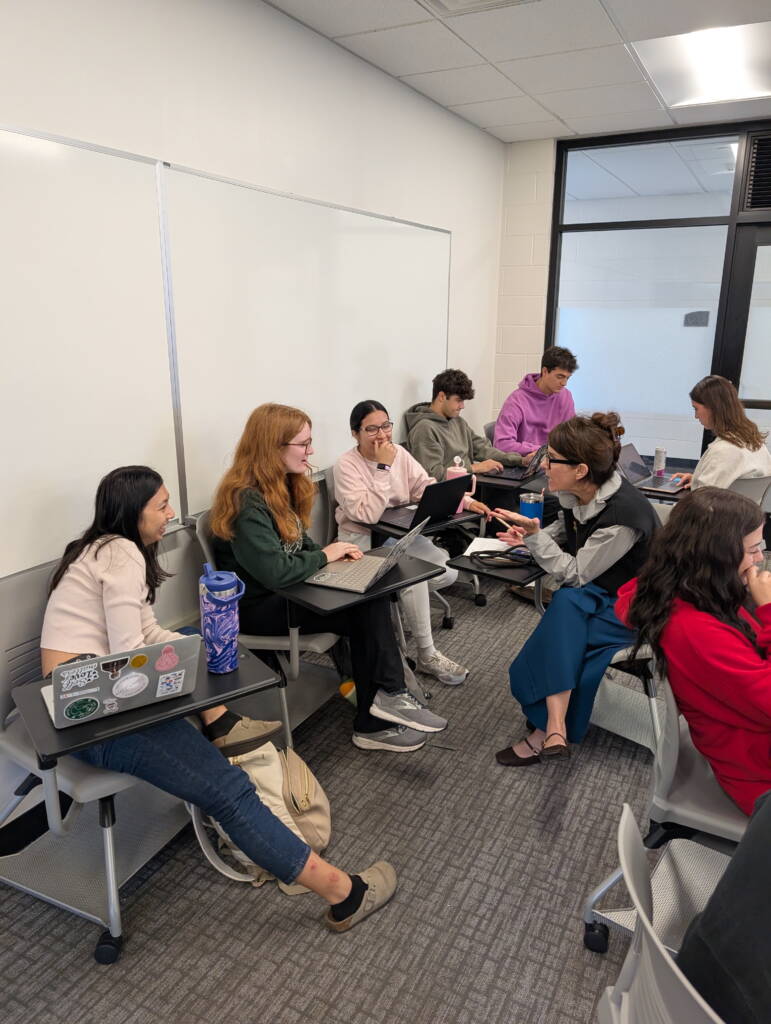
One of the key features of the class has been the involvement of staff members in various positions across the CSB and SJU campuses. At least one of two staff members per period has joined the group to discuss their own experiences and participate in class discussions.
“When I talked with Emily Paup (the program director for the gender studies minor at CSB and SJU), one of the things we discussed was the idea of bringing in guests,” dos Santos said. “I didn’t want to bring them in as guest speakers, but rather to be guest participants. I was trying to keep things as horizontal as possible. A lot of our readings focus on hierarchy and the issues it can create in the workplace, especially for people who may not have the power. So we wanted to avoid that.
“I wanted their expertise, I wanted them to bring their perspective, but I also wanted them to come in as equals to the students.”
Dailey said she has gained a lot from staff members who’ve shared their time.
“Getting to hear from staff members – some of whom I’d never met in jobs I didn’t know existed on campus – has been really valuable,” she said. “A lot of times in classes, you can get locked away studying theory and case studies. Hearing real people share actual stories about the different challenges they’ve faced, how they’ve overcome them and what guided them is refreshing.”
Luke Tahnk, a senior accounting major and one of five SJU students enrolled in the course, echoed that sentiment.
“Hearing from them has helped me better understand some of the articles we’ve been reading,” he said. “It isn’t just broad concepts. We’re talking about real dynamics in play on both the Saint Ben’s and Saint John’s campuses. Their stories have sparked discussions that have provided me with a lot more insight into perspectives I maybe didn’t think as much about before.”
That’s exactly what dos Santos wants the course to accomplish.
“For the Bennies, I want them to understand some of the individual and structural things that might impede them as they try to reach their full potential, and hopefully empower them to be agitators for change,” he said.
“For the Johnnies, I hope to introduce them to ideas that will help them become allies as they enter the workplace and navigate that world as well.
“But beyond even gender studies, I hope the class causes everyone to think even more clearly about the companies they want to work for and the missions they want to be part of,” he continued. “I want them all to feel like they can be agents of change in helping to make whatever system they get into more equitable for everyone.”
