
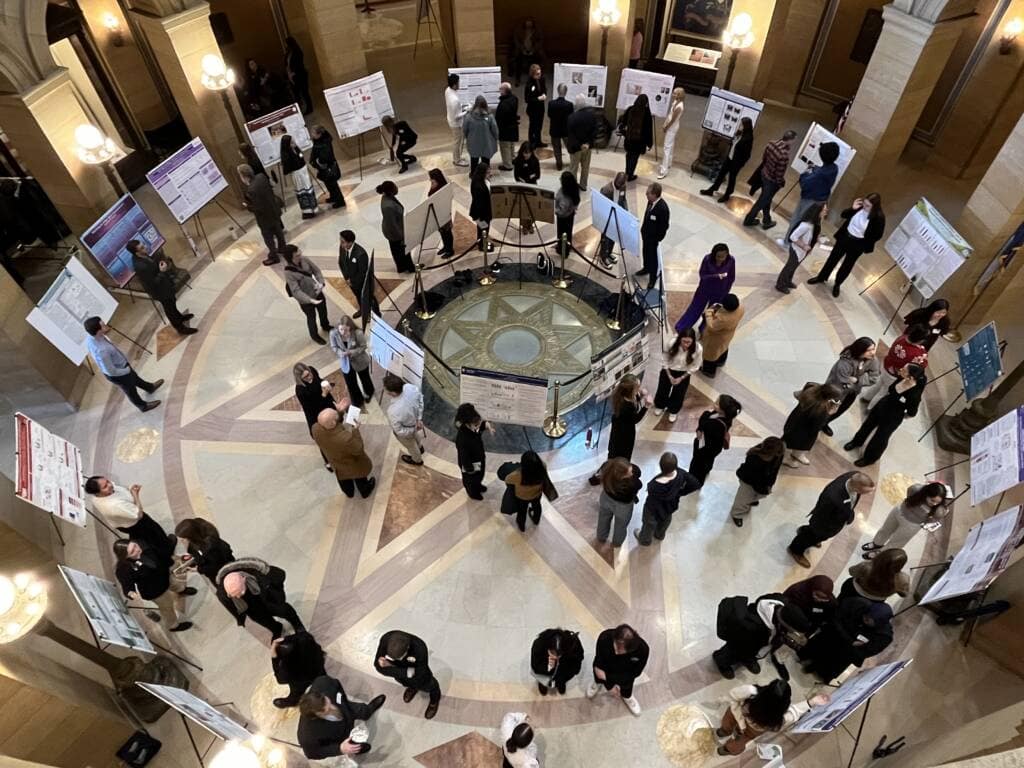
Four students from the College of Saint Benedict and Saint John’s University recently showcased their undergraduate research as part of the annual Scholars at the Capitol, an event sponsored by the Minnesota Private College Council.
Undergraduate research provides opportunities for students to explore the kinds of projects they will pursue later in their educational paths and careers.
The event was Feb. 25 at the Minnesota State Capitol and included 34 students from 15 schools around the state who presented research posters in the Capitol Rotunda in St. Paul.
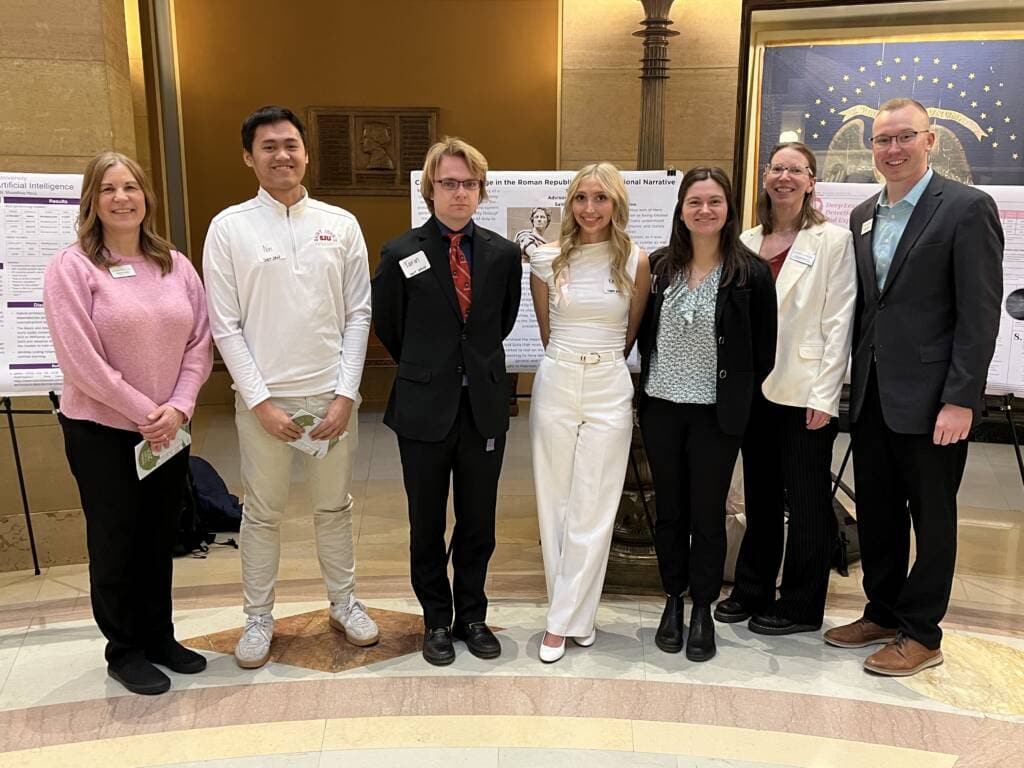
The following students represented CSB and SJU:
- Tarin Gatchell, a senior political science and classics major from Granite Falls, Minnesota
- Kendra Orbeck, a senior computer science and biochemistry major from Cold Spring, Minnesota
- Lauren Sitzman, a senior biology major from Omaha, Nebraska
- Nin Tran, a junior economics and mathematics major from Danang Da Nang, Vietnam
Gatchell’s research, under the mentorship of Jason Schlude, professor of classics and history, was titled “Causes & Methods of Constitutional Change in the Roman Republic.”
Using a narrative of the fall of the Roman Republic, Gatchell explained how constitutions change.
First, he developed a definition of a constitution as the amalgamation of traditions, customs, social mores and culture as they relate to the act of governing.
Second, he introduced and discussed theories of so-called personal and stately glory, heroic “Great Men” and legendary stories both from a society’s past and stories that are being played out and participated in by the people of an era to explain the forces of constitutional change in the Roman Republican context.
To demonstrate this, Gatchell presented a historical narrative example from the career of Julius Caesar and the Caesarean Civil War, roughly 63 through 44 BCE to demonstrate the importance of each theory (glory, heroic figures, legendary stories) in the actions of the principal “Great Men” of that era: Pompey and Caesar.
Finally, he demonstrated the importance of this framework for understanding modern politics by analyzing modern political phenomena.
Orbeck’s research, under the mentorship of Vijay Srinivas Tida, assistant professor of computer science, was titled “Deep Learning Models for Breast Cancer Detection.”
Breast cancer remains one of the most prevalent cancers among women, and early detection is critical for improving patient outcomes. However, interpreting mammographic images can be subjective and time-consuming.
This study investigated the use of deep learning models to classify mammogram images from the CBIS-DDSM dataset as benign or malignant and examined whether explainable AI can improve clinical trust in automated diagnosis.
They trained and evaluated three convolutional neural network (CNN) architectures –
EfficientNetB0, InceptionV3 and MobileNetV2 – after preprocessing DICOM images into JPEG format and organizing them by diagnostic label. Performance was assessed using accuracy and loss across training and validation sets.
To enhance interpretability, they applied explainable AI techniques such as Local Interpretable Model-Agnostic Explanations (LIME), which generated heatmaps highlighting clinically relevant regions influencing model predictions.
These findings suggested that lightweight CNN models combined with interpretability tools can support real-time decision making and help radiologists assess AI-assisted diagnoses.
Future work will include extended training, model tuning, dataset balancing and evaluation across additional imaging datasets.
Sitzman’s research, under the mentorship of Katharine Cary, assistant professor of biology, was titled “Changes in Danaus plexippus Melanization & Sexual Dimorphism Over Time.”
The goal of this study was to understand how melanization of Danaus plexippus (monarch butterflies) has changed over time between sexually dimorphic adult males and females, both east and west of the Rocky Mountains in the United States.
High melanization levels, meaning a higher percentage of black scales on wings, increase heat absorption, leading them to hypothesize that melanization has decreased over the past decades because of changing climate and location.
Fifty-eight specimens from 1900 to 2021 were photographed by the researcher or selected from the Integrated Digitized Biocollections and digitally analyzed for melanization.
A three-way general linear model showed that females had higher melanization than males, and monarchs east of the Rocky Mountains had higher melanization than monarchs found to the west, as predicted.
There were no significant interactions between the variables, with sexual dimorphism and differences between eastern and western butterflies staying stable over time.
Unexpectedly, melanization increased over time. Darker wings could help thermoregulate in varying temperatures.
Tran’s research, under the mentorship of Shuoshuo Hou, assistant professor of economics, was titled “Forecasting Labor Market Inequality with Artificial Intelligence.”
Accurate unemployment forecasting is essential for economic planning and timely policy decisions. Traditional forecasting methods often rely on lagging macroeconomic indicators and may miss rapid labor-market changes.
Real-time digital behavioral data, such as job-related Google search activity, provides immediate signals of job-seeking behavior.
This study developed a hybrid deep learning model combining Long Short-Term Memory (LSTM) and Gated Recurrent Unit (GRU) networks to forecast the U.S. unemployment rate. The model integrates monthly unemployment, GDP growth, CPI growth and seven job-related Google Trends queries.
Data are scaled using MinMax normalization and evaluated with an 80/20 train-test split. Results show that the hybrid LSTM-GRU outperforms standalone LSTM and GRU models, with an RMSE of 0.1438, MAE of 0.1111 and MSE of 0.0207.
Although the models function as black-box neural networks without direct interpretability, the improvements in forecasting accuracy demonstrate the practical value of combining traditional economic indicators with real-time search data for short-term unemployment prediction.