
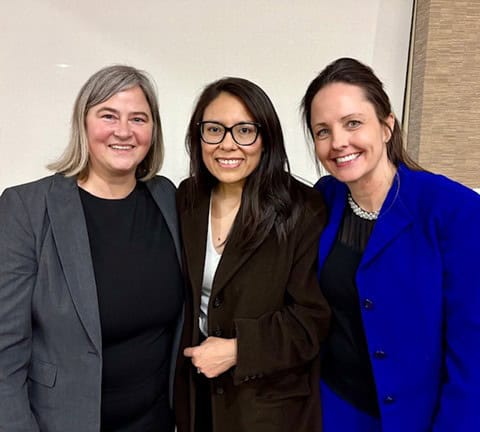
Author: Amanda Rae Severson, CSB Sophomore Psychology Major
Amid a surge in legal cases stemming from immigration arrests, a large crowd—including college students aspiring to careers in the judicial system—gathered on March 10 in the upper level of the Gorecki Center at the College of St. Benedict to gain a glimpse into the inner workings of the judiciary. The event, held intentionally during Women’s History Month, brought public political engagement and women’s empowerment to the spotlight, featuring two female speakers with extensive experience in the field and a passion for using their positions to advocate for others.
The CSB+SJU Eugene J. McCarthy Center for Public Policy and Civil Engagement sponsored the evening in collaboration with the American Association of University Women (AAUW) St. Cloud area branch, which focuses its efforts on advancing gender equity for women and girls by creating avenues for them through education, research, and advocacy.
The first keynote speaker was Deputy Chief U.S. Probation Officer Nicole Smith, who grew up near the CSB+SJU campuses. Smith began by remarking on the impact that the case of Jacob Wetterling, the eleven-year-old boy who was abducted near his St. Joseph home in 1989 and remained an unsolved case until 2016, had on her life and the pursuit of her career in criminal justice. Patty Wetterling, Jacob’s mother and national advocate for children’s safety, was in the audience. Smith expressed gratitude to Wetterling for accepting the invitation, referred to her as a hero, and highlighted Wetterling’s courage, grace, and resilience.

Smith shared an image from her teenage years, when she was featured on the front page of the St. Cloud Times while planting the Jacob Hope Garden at North Junior High School in May 1994. “Tonight, we remember Jacob and support you, Patty, and your unwavering commitment to pursue justice,” Smith said directly to Wetterling during her talk.
During her remarks, Smith conveyed her desire to mirror Patty’s impact on her life by inspiring and encouraging the students in attendance. She highlighted the 11 traits of Jacob: (1) be fair, (2) be honest, (3) be thankful, (4) be joyous, (5) be generous, (6) be understanding, (7) be positive, (8) be a good sport, (9) be a good friend, (10) be gentle with others, and (11) be kind. Smith said the world could use a little more of these traits Jacob valued—especially kindness, honesty, and fairness.
Smith attended Apollo High School and graduated from St. Cloud State University (SCSU), where she first interacted with federal law enforcement at a school career fair. Smith attended SCSU when John H. Campbell, Ph.D., taught criminal justice after he had previously served as the unit chief of the Federal Bureau of Investigation’s Behavioral Science Unit.
While attending SCSU, Smith said a juvenile justice professor cancelled class the day of the career fair, a ruse to increase attendance. It was a chilly morning when she arrived for class only to find a sign posted on the classroom door directing students to report to an auditorium elsewhere. Smith spoke of her irritation at the time, as it predated cancellation notices sent via an app, text, or email. Admittedly, she said, if she had known in advance, she likely would not have attended and opted to pick up extra hours at work.
However, as fate would have it, she met a woman at the career fair who was a federal law enforcement officer and a former U.S. Pretrial Services Officer. The officer discussed her passion and her work on behalf of the federal judiciary with Smith—an interaction that Smith later said sparked her first real interest in a career in law enforcement. Just as importantly, the officer was a woman, which allowed Smith to see herself in that role. In a humorous tone, she mentioned that later learning how federal careers come with pensions and early retirement options helped affirm this calling.

Smith shared her own experience as Deputy Chief and the value of this role. “We are the eyes and ears of the court and take pride in advancing the administration of justice to aid the court in the rule of law,” Smith said.
She commented that she and Chief U.S. Probation Officer Maribel Andrade-Vera, who was also in attendance at the event, take great pride leading a team of skilled staff on behalf of the Court which prepares written investigative reports to aid in release, detention, and sentencing decisions, all while supervising more than 1,000 justice-involved individuals spanning all 87 counties and nearly 87,000 square miles across Minnesota. This supervision is necessary to enforce court-imposed release conditions.
Smith noted that this responsibility comes with significant adversity, especially in the current political climate. “The work performed is not done in a vacuum. It can be very challenging, not necessarily due to strict deadlines but to meet statutory obligations and to work with extraordinarily complex human beings—addressing behaviors and societal issues,” Smith said.
While the role comes with long days and sacrifice, Smith said she is proud of the work she and her colleagues do, and the transformation seen in the individuals they serve. Smith is going on her 24th year in federal law enforcement and said the learning opportunities are continuous.
Beyond the District’s frequent presence in the news, Smith concluded her remarks by highlighting other ways the District is making history. For the first time in Minnesota, the three Court Unit Executives are all women: Kate Fogarty, Clerk of the U.S. District Court; Maribel Andrade-Vera, Chief of U.S. Probation and Pretrial Services; and Tricia Pepin, Clerk of the U.S. Bankruptcy Court. Smith celebrated by showing photos of these women side by side. To the audience’s applause, Smith added that, for the first time, both the Chief and Deputy Chief of the Probation and Pretrial Services Office in Minnesota are women.
Introducing the second keynote speaker were political science students who served as emcees for the event: Cecilia McNair (CSB+SJU junior and former legislative intern for Senator Tina Smith) and Maria Shaver (SCSU first-year and current vice president of the AAUW student organization).
“It is our pleasure to introduce the Honorable U.S. District Judge Laura Provinzino tonight,” McNair and Shaver said together, revealing the “mystery guest” whose identity was not revealed until the beginning of the event for security reasons.
Like Smith, CSB+SJU played a role in Provinzino’s life, with her father having played football for St. John’s University and her having taught in the Upward Bound program at CSB+SJU. This long-running program prepares first-generation and low-income high school students for college success.
“The College of St. Ben’s and St. John’s shaped me long before I stepped into a courtroom, so it is an honor to be back,” Provinzino said.
Provinzino grew up in St. Cloud and graduated from St. Cloud Tech High School, where she earned an AAUW Scholarship. After graduation, she attended Lewis & Clark College in Portland, Oregon, and attended the University of Oxford on a Rhodes Scholarship before studying law at Yale Law School. Provinzino noted the powerful impact these scholarships had on her career success and on her belief in giving back and supporting the young women who follow in her footsteps.
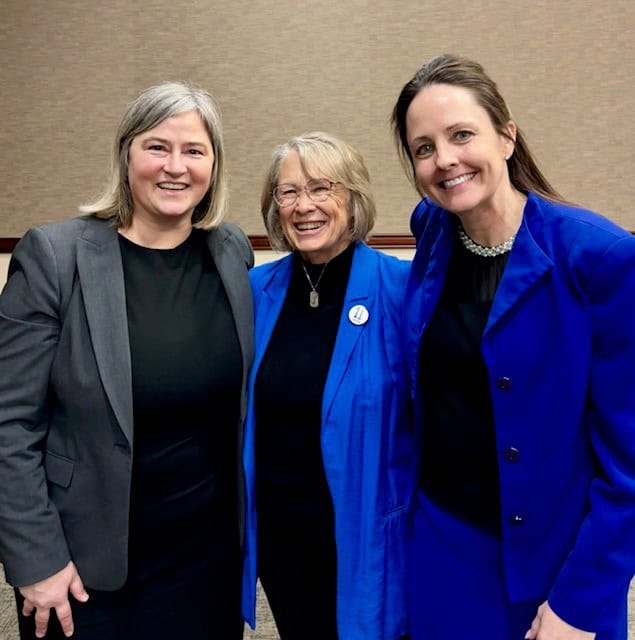
After her introduction, Provinzino shared the early origins of her life’s ambition, which has culminated in her nomination by former President Biden and a bipartisan Senate vote into the seat she now holds. At the age of six, she heard that former President Reagan had appointed Sandra Day O’Connor as the first woman to the U.S. Supreme Court. Staging her talk, she shared a quote by Justice O’Connor that informs her community work:
“We don’t accomplish anything in this world alone … and whatever happens is the result of the whole tapestry of one’s life and all the weavings of individual threads from one to another that create something.”
Throughout her career, including as a former Assistant U.S. Attorney in the District of Minnesota, Provinzino’s cases have ranged from human trafficking prosecution and sexual abuse to missing and murdered Indigenous peoples and immigration. Before she was appointed a U.S. District Judge in 2024, Provinzino received the Attorney General’s David Margolis Award for Exceptional Service, the Attorney of the Year award from Minnesota Lawyer, and the Women in Federal Law Enforcement (WIFLE) Top Prosecutor Award.
Provinzino highlighted notable casework, including a Title IX matter in which she and her former law firm prevailed, allowing girls to play in the same arena as boys for the state high school hockey tournament, in addition to two human trafficking and sexual abuse cases (United States v. Sukhtipyaroge, No. 17-CR-208 and United States v. Lazzaro et al., No. 21-CR-73).
In an era where the judiciary is under intense public scrutiny, Provinzino shared that some of the judges have faced personal threats, many of which are amplified by social media. “Through all of it, the judiciary has upheld its core commitments,” Provinzino said. “I approach judging from a place of curiosity … and never fear.”
She also emphasized the purpose and resilience of the law in the face of such challenges. “The law exists to protect people: The powerful and the powerless; the rich and the poor; the old and the young; U.S. citizens and non-citizens,” Provinzino said. “That understanding is what I carry with me onto the bench each and every day.” As with Smith, Provinzino referred to Patty Wetterling’s advocacy and the 11 traits of Jacob as influences on her life and work.
Following Provinzino’s keynote, McNair and Shaver engaged the judge with several questions before they took some from the audience. Before addressing these, Provinzino briefly referenced the Code of Conduct and the restrictions on judges’ actions and speech, emphasizing that their impartiality cannot be called into question. In her answers, she offered advice to overcoming barriers for young women and students aspiring to careers in law or the judiciary, provided insight into the federal court system and how it differs from state courts, and discussed pressing legal challenges and the tools courts use to ensure compliance with their orders.
SJU sophomore Patrick Immelman attended the event and said that it was particularly impactful to meet these figures in today’s political landscape. “I thought it was pretty interesting to get an inside scoop from someone in the judiciary system,” Immelman said. “Especially because right now, they’re under a lot of tension with the executive branch.”
The evening was filled with moments of connection and shared experience. For one thing, Provinzino and Smith both mentioned that their mothers were in attendance as well as their former grade-school teachers, including Provinzino’s fifth-grade teacher, Fay Bolin, and Smith’s fourth-grade teacher, Joyce Hummel. They also had connections with the student emcees: Provinzino and Shaver are graduates of Tech High School, and Smith and McNair are graduates of Apollo High School—where Provinzino’s mother also taught.
As a St. Ben’s psychology major and the author of this article, attending the event gave me not only a deeper understanding of public service opportunities in the federal judiciary but also a meaningful personal connection. Born and raised in Minnesota, I grew up well acquainted with Jacob Wetterling’s story and Patty Wetterling’s tireless advocacy for justice. My mother, a 1991 graduate of CSB+SJU and former writer and editor for The Independent (CSB’s school newspaper at the time), interviewed Patty in the Wetterling home in 1990 for a feature story that honored her determination to find Jacob, dedication to child safety, and unshakeable spirit on the one-year anniversary of his abduction. Toward the end of the evening at St. Ben’s—an event rich in inspiration, hope, and empowerment—I experienced a full-circle moment when I met and shook hands with Patty, a woman whose story remains ever close to my heart and mind.
The event was coordinated by Whitney Court, Ph.D., Professor and Chair of the CSB+SJU Political Science Department, along with Anastasia Nathe, Assistant at the McCarthy Center. Dr. Court acknowledged Provinzino, Smith, McNair, and Shaver, along with the St. Cloud AAUW, the McCarthy Center, and faculty members from CSB+SJU and SCSU, thanking them for their support.
Eugene McCarthy came to the Lewis & Clark College campus in 1995 (Judge Provinzino attended from 1994-1998, B.A., 1998) at the invitation of two of her Lewis & Clark professors — who met while working on his Presidential campaign in 1968 — for a common first-year course called Inventing America. McCarthy spoke at the campus chapel. Judge Provinzino stated it was fascinating to get a glimpse into that time period when her parents were in college from McCarthy’s first-hand account.