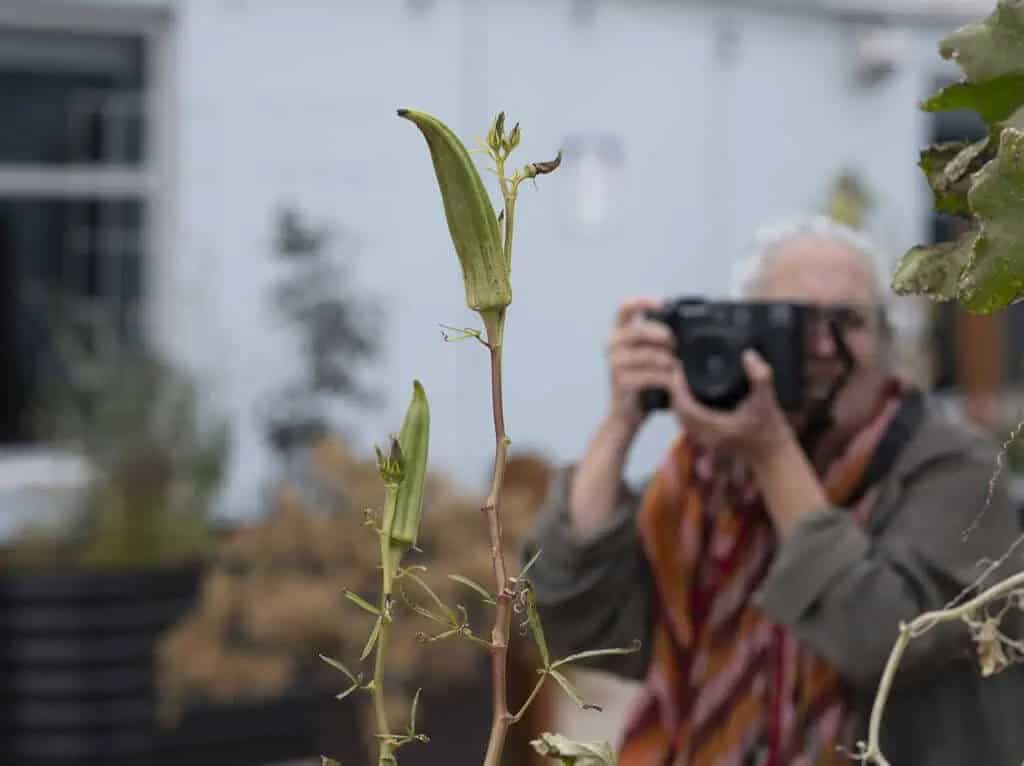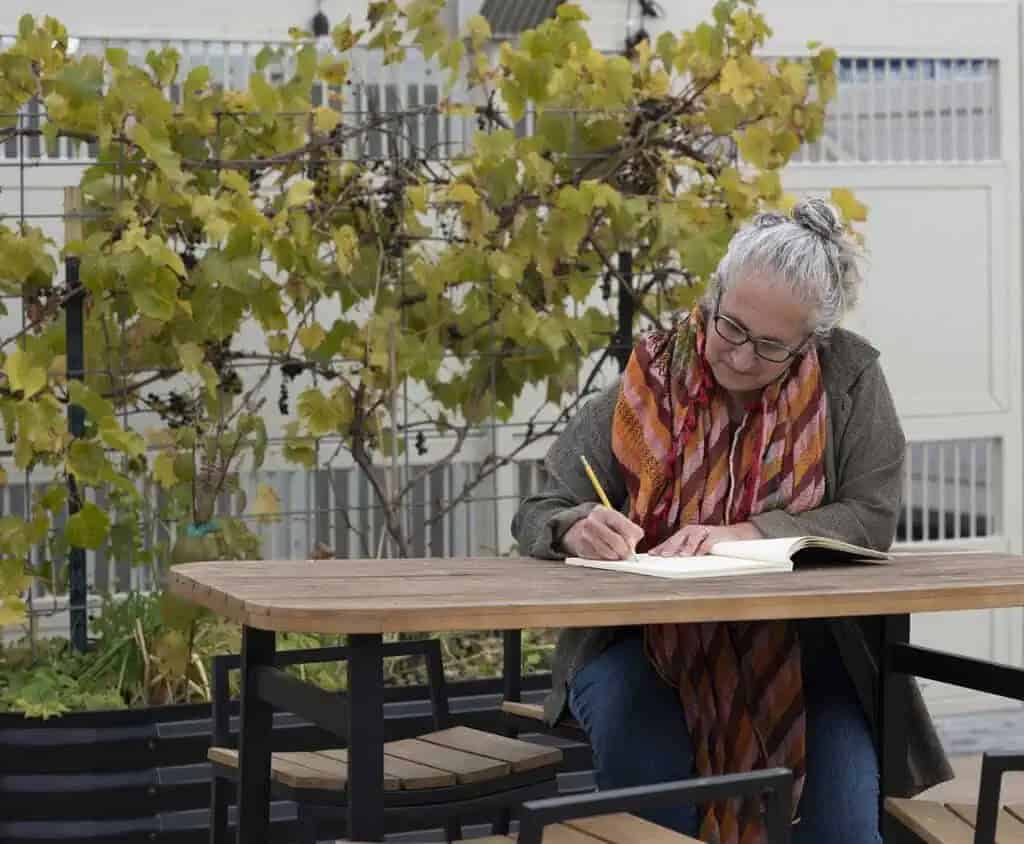
Youla Nassif for the Arab American National Museum, © 2025
For Andrea Shaker, it was an opportunity to grow and expand as an artist while more fully exploring her own heritage.
That’s why the professor of art at the College of Saint Benedict and Saint John’s University jumped at the chance to fill one of the handful of artist-in-residence slots offered each year by the Arab American National Museum (a Smithsonian affiliate) in Dearborn, Michigan.
Shaker, who grew up in Connecticut, spent September and October at the museum exploring the archives, putting together a series of photography books focusing on the reclamation of the Arabic language lost to assimilation and immersing herself in the surrounding culture of Dearborn, the first Arab majority city in the U.S.
“They typically offer five or six slots per year,” said Shaker, an Arab American herself. “They do a call for applications, and mine was accepted. That felt like quite an honor because it’s open to artists across the full spectrum of the fine arts – whether it’s in the visual, literary or performing arts.
“The museum is the only institution in the country dedicated to telling the Arab American story through our own voices,” she continued. “That’s very significant to our community because oftentimes our story is told in other ways by non-Arab voices in media and other platforms. And sometimes – though certainly not all – that coverage is not favorable.”

Shaker said the resources the museum offered allowed her to take a deep dive into the history of the Arab American experience in this country.
“To be able to live in Dearborn for two months and spend time researching in the Museum’s archives and collections was transformative to me as an Arab American artist,” said Shaker, whose own work is interdisciplinary in nature, blending writing, photography and even experimental films.
“I was able to access a rich and growing archive of photographs, written documents, objects and more that tell the story of the Arab migration to the U.S. over different periods and waves. I spent a lot of time in the library and archives researching. Having all that at my fingertips was incredible.”
The result is a series of small hand-held artist’s books titled (re)claiming and (re)constructing my mother tongue, which blends her own writing and photos with other materials discovered in the archives looking at the experience of Arab immigrants during different periods as they attempted to maintain their cultural heritage and traditions while making a new home in the US.
“I was exploring the idea of what a mother tongue means in the sense of belonging, and what the partial or full loss of that mother tongue as a result of the forces of assimilation might mean as well,” she said. “I was able to do a lot of reading and researching in the museum archives, particularly looking at migratory images over different periods of time. There was a valuable photo album of family photographs from 1925 to ’27 I came across that I was able to use and fit into my work.
“The idea is that the books from this series could be placed in spaces where people can interact with them. They are small and fit within the palm of one’s hand. This intimacy is intentional,” she added. “It looks like there are four libraries in the Dearborn and surrounding areas – including two public and two university – interested in having them available for their patrons and constituents. The idea is to launch the project in early April (2026), which is Arab American Heritage Month.
“Hopefully, this work can create a larger community discussion around the idea of what a mother tongue is and how it relates to our identities and our senses of belonging and community.”
Shaker had visited Dearborn briefly on three other occasions but said this was the first chance she’d really had to explore the community.
“It happens to be the city in the U.S. with the highest concentration of Arab Americans, and it was incredible for me to look around and see the restaurants, coffee shops and storefronts where a good portion of the signs are in both English and Arabic,” she said. “When you go to the grocery store, oftentimes Arabic is the predominant language you hear spoken.
“That was one beautiful takeaway I got from the experience, just feeling that sense of being very at home surrounded by the sights and sounds of Arabic culture.”
Shaker – who is on professional leave from CSB and SJU this semester – also said it was beneficial to take the time to slow down and think more deeply about her own art, culture and beliefs.
“One of the other big aspects that came from this, in terms of what I will bring back to my own students, is an even greater appreciation of the importance of being true to your compass and what your truths are,” she said. “That’s something that’s important whether you are a student taking one art class, or an art major taking multiple classes.
“We all have our own background and history, and I think it’s essential to understand and acknowledge what they mean to us. Art has the power to uniquely express these histories and identities. It also has the potential to comment on them and to create meaningful community dialogues.”
“Another takeaway that was further reinforced, and that I will bring back for students, is that the artistic process is something to spend time with and that art is something to fully understand through our hearts, minds and bodies – our full being,” she added. “Spending time with this process can result in art experiences that are transformative for ourselves and our communities.
“I would say that this expression and dialogue are at the root of the Benedictine liberal arts at CSB and SJU.”